

Critical Communications for Airport Safety and Security
Airports operate as complex ecosystems where communication failures can compromise safety, security, and operational efficiency. In today’s aviation environment, reliable wireless infrastructure is not just beneficial – it is essential. From coordinating aircraft movements to responding to security threats, airports depend on seamless communication networks to protect passengers, staff, and assets while maintaining regulatory compliance.
Yet many airports face significant challenges in ensuring comprehensive wireless coverage across their expansive facilities. Traditional communication systems often fall short when reliability matters most, creating vulnerabilities that no aviation facility can afford.
Airport communication systems are integrated wireless technologies that ensure clear, reliable communication between airport staff, first responders, and security teams across terminals, runways, and support facilities.
The Critical Role of Communication in Airport Operations
Modern airports function as miniature cities, requiring constant coordination among diverse teams operating across vast, complex environments. These facilities depend on integrated communication systems to manage multiple critical functions simultaneously.
Airport operations teams rely on wireless communication for daily coordination activities, including aircraft ground handling, baggage management, and passenger flow optimization. Security personnel require instant communication capabilities to respond to threats, coordinate with law enforcement, and maintain situational awareness across terminals, parking facilities, and restricted areas.
Transportation Security Administration (TSA) agents and customs officials need reliable connectivity to access real-time security databases, coordinate screening operations, and communicate with federal agencies. Maintenance crews depend on clear communication channels to coordinate repairs, manage equipment, and ensure facility safety across terminals, runways, and support buildings.
Air traffic control coordination, emergency response protocols, and inter-agency communication all require robust, interference-free wireless networks. When communication systems fail or experience degraded performance, the consequences extend far beyond operational inconvenience – they create serious safety and security vulnerabilities.
Communication Challenges Facing Aviation Facilities
Airport environments present unique obstacles that traditional wireless systems struggle to overcome. These challenges stem from both the physical characteristics of airport infrastructure and the demanding operational requirements of aviation facilities.
Signal Interference and Dead Zones
Airport terminals, hangars, and parking structures create complex RF environments where signals struggle to penetrate. Metal aircraft, concrete structures, and underground tunnels create dead zones that leave critical personnel disconnected when communication is most needed.
Network Congestion During Peak Operations
Commercial cellular networks become overloaded during high-traffic periods as thousands of passengers simultaneously access voice and data services. This congestion can block emergency calls, delay critical communications, and disrupt coordination between operational teams.
Regulatory Compliance Requirements
Federal Aviation Administration (FAA) and Transportation Security Administration (TSA) regulations mandate specific communication capabilities for emergency response, security operations, and coordination with first responders. Many existing systems fail to meet these stringent requirements consistently.
Multi-Agency Coordination Complexity
Federal Aviation Administration (FAA) and Transportation Security Administration (TSA) regulations mandate specific communication capabilities for emergency response, security operations, and coordination with first responders. Many existing systems fail to meet these stringent requirements consistently.
Outdoor-to-Indoor Coverage Gaps
Ground crews, baggage handlers, and security personnel frequently move between indoor terminals and outdoor operational areas. Inconsistent coverage between these environments disrupts communication and reduces operational efficiency.
These communication gaps create vulnerabilities that compromise safety, reduce operational efficiency, and limit airports’ ability to provide secure, seamless passenger experiences. Modern airport operations require integrated solutions that address these challenges comprehensively.
MCA Solutions: Comprehensive Wireless Infrastructure for Aviation
At MCA, our team of certified professionals specializes in delivering integrated communication solutions tailored to the unique challenges of airport environments. For over 30 years, we have provided aviation facilities with mission-critical wireless infrastructure that enhances safety, improves operational efficiency, and ensures regulatory compliance.
Our comprehensive approach combines industry-leading technology with extensive engineering expertise to create wireless networks that support current operational requirements while anticipating future technological demands. Through direct partnerships with leading technology providers and our service-first commitment, we deliver turnkey solutions that keep airports connected and secure.
MCA’s aviation communication solutions encompass public safety radio enhancement, cellular coverage optimization, private radio networks, and advanced private wireless infrastructure. Our expert teams assess your facility’s unique requirements, engineer customized solutions, and provide ongoing support to ensure your communication systems perform reliably when it matters most.
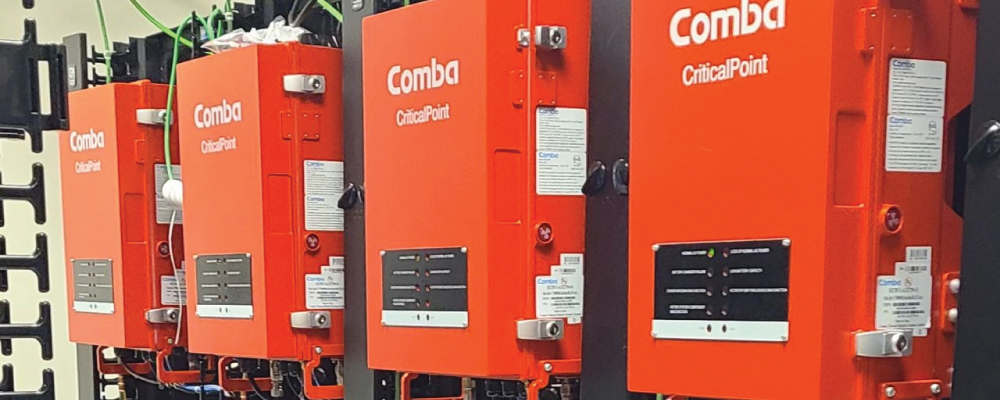
Public Safety DAS (ERCES): Emergency Responder Communication Enhancement
ERCES (Emergency Responder Communication Enhancement System) is a mandated public safety DAS that ensures first responder radios function in every area of an airport facility.
Emergency Responder Communication Enhancement Systems ensure first responder radios function seamlessly throughout every area of airport facilities, eliminating communication dead zones that could delay critical response during emergencies. These systems provide reliable coverage in challenging areas, including underground tunnels, parking garages, baggage handling facilities, and aircraft maintenance hangars.
ERCES implementation is mandated by local, state, and federal building codes, which require airports nationwide to maintain communication systems that enable rapid emergency response. Our public safety DAS solutions exceed these requirements by providing comprehensive coverage that supports coordination between multiple agencies during crises.
These systems integrate with existing emergency response protocols while providing the reliability and coverage area necessary for effective incident management. When properly designed and installed, ERCES solutions ensure that police, fire, and emergency medical personnel can communicate clearly regardless of their location within airport facilities.

Signal Boosters (Cellular DAS): Enhanced Mobile Connectivity
Cellular DAS (Distributed Antenna System) is an infrastructure designed to improve LTE and 5G coverage throughout airport facilities, ensuring reliable mobile communication for staff and passengers.
Distributed Antenna Systems designed for cellular enhancement can be configured as single-carrier or multi-operator solutions, significantly improving in-building LTE and 5G coverage and capacity for smartphones and tablets throughout airport facilities. These systems support both passenger mobile devices and staff communications equipment used for critical operations.
Cellular DAS solutions ensure reliable connectivity for emergency 911 calls, mobile security applications, and operational coordination tools. By providing consistent signal strength across all areas of airport facilities, these systems eliminate the frustration and safety risks associated with poor cellular coverage in critical locations.
Our cellular enhancement solutions integrate seamlessly with existing infrastructure while providing the scalability necessary to support growing data demands from both passengers and operational systems. This comprehensive coverage supports enhanced passenger experiences while maintaining the communication reliability essential for airport operations.
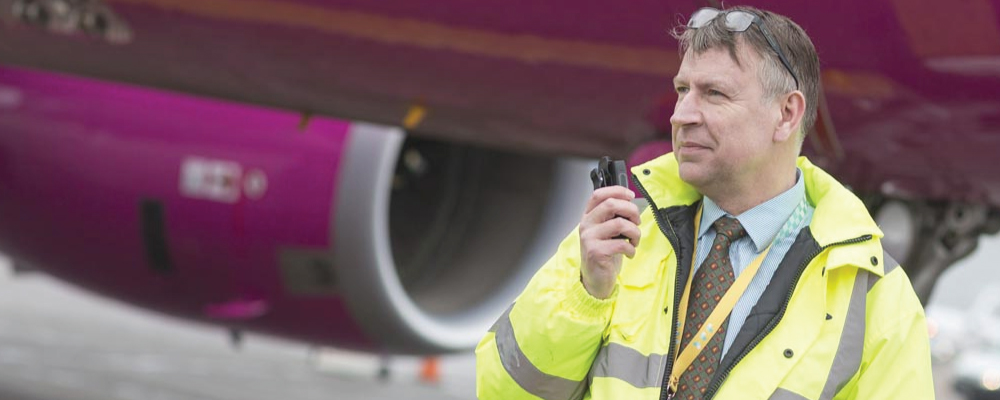
Private Radio Systems (MOTOTRBO™): Secure Campus-Wide Communication
Private radio systems like Motorola MOTOTRBO™ are dedicated two-way radio networks that deliver secure, interference-free communication for large airport teams.
Large airports and airline operations depend on MOTOTRBO two-way radio systems for secure, interference-free communication across their entire operational footprint. These professional-grade portable radios, supported by robust infrastructure systems including Capacity Plus and Capacity Max platforms, deliver instant push-to-talk capabilities for seamless coordination among diverse operational teams.
MOTOTRBO Capacity Plus systems support up to 1,600 radios at a single site, while Capacity Max platforms can accommodate up to 3,000 radios, providing the scalability necessary for major aviation facilities. These systems ensure reliable communication for security officers, ground crews, maintenance personnel, and administrative staff, regardless of facility size or operational complexity.
The secure nature of private radio systems makes them ideal for sensitive airport operations where confidentiality and reliability are paramount. These networks operate independently of commercial cellular infrastructure, ensuring consistent performance during peak passenger periods and emergencies when commercial networks may become congested.

Nokia Digital Automation Cloud (DAC): Advanced Private Wireless Infrastructure
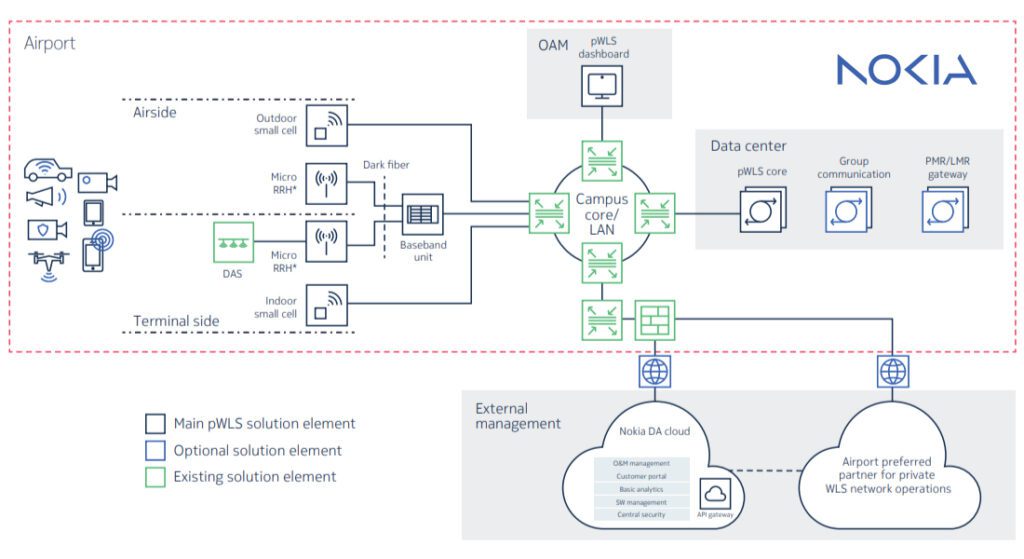
Private wireless networks (LTE/5G) provide airports with dedicated, carrier-grade infrastructure that supports automation, asset tracking, security, and real-time operational communication.
For airports requiring next-generation connectivity solutions, Nokia’s Digital Automation Cloud provides comprehensive private wireless infrastructure that combines carrier-grade 4G/LTE and 5G capabilities with edge computing and secure network management. This unified platform delivers deterministic Quality of Service (QoS) and ultra-low latency communication across all airport operational zones.
Nokia DAC solutions enable true convergence between IT, OT, and airport operations by eliminating wireless coverage gaps and providing seamless control across departments, assets, and workflows. The platform supports mission-critical applications, including smart asset tracking, operational automation, enhanced security systems, and real-time analytics, while maintaining the reliability essential for aviation environments.
These private wireless networks provide airports with complete control over bandwidth allocation, latency management, and security policies, enabling confident deployment of next-generation applications. The integration of edge computing capabilities enables real-time decision-making and automated workflows, thereby enhancing both operational efficiency and the passenger experience.
Why Airports Choose MCA for Communication Solutions
MCA has established itself as the trusted partner for airports requiring an integrated communication infrastructure that meets the demanding requirements of modern aviation operations. Our team combines decades of experience in mission-critical communications with comprehensive knowledge of aviation-specific challenges and regulatory requirements.
With over 100 solution centers nationwide, we provide the local service and support that airports need while leveraging the resources and expertise of a national organization. Our cross-disciplinary teams collaborate to deliver solutions that address immediate operational needs while providing the scalability necessary for future growth and technological advancement.
Our service-first approach ensures that your communication systems receive ongoing support and maintenance to maintain peak performance. From initial system assessment through installation, testing, and ongoing optimization, MCA provides the expertise and resources necessary to keep your airport connected and secure.
Contact Our Expert Team Today
Modern airports cannot afford communication system vulnerabilities that compromise safety, security, or operational efficiency. MCA’s comprehensive wireless solutions provide the reliable, scalable infrastructure necessary to support complex aviation operations while meeting stringent regulatory requirements.
Our team of certified professionals is ready to assess your facility’s communication needs and engineer solutions that deliver measurable improvements in coverage, reliability, and operational capability. Contact MCA today to discover how our integrated communication solutions can enhance your airport’s safety, security, and operational performance.
Partner with MCA to create a more connected, secure, and efficient airport environment that meets the challenges of today’s aviation industry while preparing for future technological advancement.
Frequently Asked Questions About Airport Communication Systems
Airports struggle with signal interference, network congestion during peak traffic, coverage gaps between indoor and outdoor spaces, and the need for multi-agency coordination between TSA, customs, police, and fire departments.
ERCES (Emergency Responder Communication Enhancement Systems) are mandated by code to ensure reliable radio coverage for police, fire, and EMS personnel across all areas of an airport, including parking garages, tunnels, and maintenance hangars.
Cellular DAS enhances LTE and 5G coverage across terminals and facilities, ensuring reliable passenger connectivity, supporting emergency 911 calls, and enabling mobile apps used for security and operational coordination.
Professional-grade radios like Motorola MOTOTRBO provide secure, interference-free communication for ground crews, security staff, and maintenance teams. Unlike consumer networks, they remain reliable during emergencies and peak travel times.
Private LTE/5G networks provide airports with complete control over coverage, bandwidth, and security. They support automation, asset tracking, video surveillance, and real-time analytics, ensuring operational efficiency and enhanced passenger safety.
MCA has decades of expertise in mission-critical communications, offering ERCES, cellular DAS, MOTOTRBO radio systems, and private wireless infrastructure tailored to aviation facilities. Our service-first approach ensures compliance, reliability, and scalability.
About MCA
MCA is one of the largest and most trusted technology integrators in the United States, offering world-class voice, data, and security solutions that enhance the quality, safety, and productivity of customers, operations, and lives.
More than 65,000 customers trust MCA to provide carefully researched solutions for a safe, secure, and more efficient workplace. As your trusted advisor, we reduce the time and effort needed to research, install, and maintain the right solutions to make your workplace better.
Our team of certified professionals across the United States delivers a full suite of reliable technologies with a service-first approach. The MCA advantage is our extensive service portfolio to support the solution lifecycle from start to finish.
