
Strengthening Railway Connectivity with Durable Antennas for Passenger Trains, Freight, and Infrastructure
Railway networks, whether for public transit or commercial freight, depend on reliable communication systems to ensure safe, efficient, and seamless operations. From Positive Train Control (PTC) systems and passenger Wi-Fi to wayside communication infrastructure, connectivity plays a vital role in monitoring, managing, and optimizing train movement.
As railway communication systems become increasingly complex, integrating 5G, Wi-Fi, and GPS technologies, rugged, high-performance antennas have become essential for maintaining uninterrupted connectivity under all conditions. Partnering with Mobile Mark, MCA offers state-of-the-art antenna solutions explicitly engineered for railway applications. These antennas deliver high-speed data transmission, real-time monitoring, and unparalleled network reliability, supporting every facet of modern railway operations.
The Importance of Reliable Antennas in Railway Operations
Railway systems depend on constant, real-time communication to ensure safety, efficiency, and a seamless passenger experience. Reliable antennas are critical to support applications such as:
- Passenger connectivity: Providing Wi-Fi and entertainment systems for enhanced rider satisfaction.
- Fleet tracking and telemetry: Monitoring train diagnostics and system health in real-time.
- Railway safety and compliance: Enabling systems like Positive Train Control and automated signaling for accident prevention.
- Wayside infrastructure: Facilitating trackside communication and effective station management.
- Freight monitoring: Overseeing logistics, security, and temperature tracking for cargo.
- Equipment ruggedization: Railways operate in harsh conditions, such as extreme weather, constant vibration, and high levels of electromagnetic interference. This demands antennas that are rugged, high-performance, and compliant with industry standards.
Mobile Mark’s antennas are designed to meet these challenges and comply with NFPA-130 certification, a stringent safety standard for fixed guideway transit and passenger rail systems. NFPA-130 requirements ensure that all equipment, including antennas, meets fire resistance, smoke emission, and operational safety standards critical for railway environments. With Mobile Mark, you get antennas that deliver durability, reliability, and compliance for even the most demanding rail applications.
Key Antenna Solutions for Railway Applications
MCA offers a wide range of specialized antennas from Mobile Mark, designed to meet the unique demands of modern railway operations. These solutions address critical areas, including passenger connectivity, safety systems, and infrastructure communication, ensuring seamless and reliable performance across the entire rail network.
1. Passenger Cars and Rail Vehicles
Passenger experience is a top priority for modern rail transit operators, as expectations for seamless connectivity and convenience continue to rise. With the increasing adoption of Wi-Fi and 5G connectivity, passengers anticipate uninterrupted internet access for work, entertainment, and communication during their travels. Additionally, train operators require a robust communication infrastructure to facilitate essential services such as ticketing, onboard telemetry, and real-time operational data exchange. Addressing these needs ensures an enhanced travel experience for passengers while improving the efficiency and reliability of operational workflows.
Recommended Solutions:
- PR-LTMG508 and PR-LLPG508: NFPA-130 compliant multiband antennas supporting 2× 5G/LTE, 2× Wi-Fi, and 1× GNSS for passenger rail applications. These antennas deliver reliable onboard connectivity for seamless passenger internet access and operational communications.
- PR-NXD-W: A low-profile Wi-Fi hotspot antenna featuring 4× MIMO Wi-Fi, providing strong and consistent internet connectivity within passenger compartments.
Benefits:
- Consistent onboard Wi-Fi connectivity for passenger convenience.
- Reliable voice and data communication for train operators to ensure smooth operations.
- Support for streaming, entertainment, ticketing, and other passenger-facing systems.

From left to right: PR-LTM508 antenna, PR-NXD-W antenna, Y3323C-B antenna, PR-LLPG508 antenna
2. Positive Train Control (PTC)
Positive Train Control (PTC) systems are federally mandated safety technologies designed to improve rail safety and prevent accidents. These systems are crucial for avoiding train collisions, enforcing speed limits, and controlling signaling operations. PTC relies heavily on dedicated 220 MHz wireless networks to ensure constant communication between locomotives, trackside equipment, and centralized train control centers. The success of PTC systems depends on highly reliable antennas that can handle long-range communication with minimal signal loss, supporting real-time data transfer and location accuracy. With safety as the cornerstone of rail operations, PTC antennas are essential for maintaining compliance and preventing human error.
Recommended Solutions:
- TB-GNSS: A Tri-Band GNSS antenna supporting L1/L2/L5 frequencies with RHCP polarization, ensuring highly accurate positioning and location tracking.
- Y3323C-B: A directional Yagi antenna covering 210-225 MHz with 8 dBi gain, ideal for reliable long-range communication in PTC systems.
- Y6625D: A high-gain enclosed Yagi antenna, configurable as bi-directional, for enhanced performance in PTC and signaling operations.
- EDX220: A folded dipole antenna specifically designed for 220 MHz PTC networks, ensuring consistent coverage and minimal signal loss.
Benefits:
- Continuous train-to-trackside communication for real-time data sharing.
- High-accuracy location tracking to enforce safety measures and speed limits.
- Seamless integration with centralized rail network management systems.
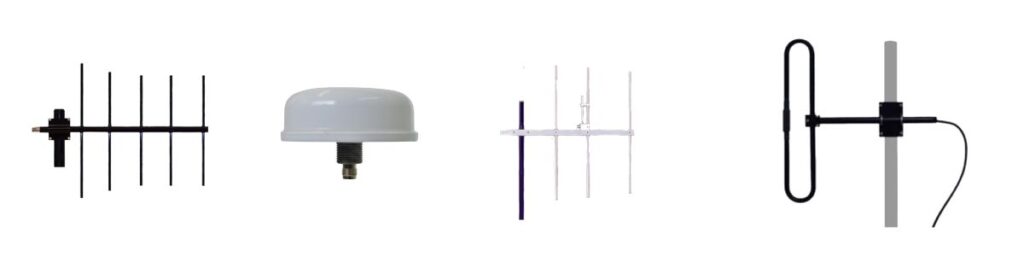
From left to right: Y6625D antenna, TB-GNSS antenna, Y3323C-B antenna, EDX220 antenna
3. Rail Wayside Infrastructure
Trackside communication systems and wayside infrastructure are vital for the efficient management and monitoring of rail networks. These systems enable the transmission of critical data over long distances, ensuring effective oversight of train movement, cargo tracking, and station control. Rail yards and signaling networks also require durable, high-performance antennas to maintain operational efficiency in rugged environments. With the rise of smart rail applications, these antennas play a key role in supporting low-latency communication, safety monitoring, and large-scale data exchange. Reliable trackside infrastructure ensures smooth communication between trains, stations, and control centers, enhancing overall railway performance and safety.
Recommended Solutions:
- BSLL220XL3-C: A base station omni antenna optimized for 220 MHz railway frequencies, providing reliable long-distance communication.
- BPN942: A 7-in-1 multiband antenna supporting 4× 5G/LTE, 2× Wi-Fi 6E/7, and 1× GPS, ideal for private rail networks requiring advanced connectivity solutions.
- BSLL450XL4.5-C: A rugged base station omni antenna covering 450-480 MHz, designed for train yard communications and intermodal tracking.
- BSLL800UWB and BSLL915XL: Omni-directional antennas designed for 806-960 MHz and 900-930 MHz ISM bands, delivering low-latency communication and reliable performance for smart rail applications.
Benefits:
- Uninterrupted communication between stations and moving trains for improved coordination.
- Enhanced safety monitoring and emergency response capabilities.
- Efficient handling of large-scale data exchange in freight yards, train depots, and signaling networks.

From left to right: BSLL220XL3-C antenna, BPN942 antenna, BSLL450XL4.5-C antenna
These cutting-edge antenna solutions ensure that every aspect of railway communication, from passenger connectivity to safety and infrastructure, is supported with unmatched reliability and performance. Whether you’re focused on enhancing passenger experience, meeting federal safety standards, or improving operational efficiency, MCA has the right antenna for your railway needs.
Why Choose MCA for Your Railway Antenna Solutions?
In collaboration with Mobile Mark, MCA provides cutting-edge antenna solutions tailored to meet the demanding requirements of modern railway systems. Our solutions deliver:
- Unmatched Durability: Engineered for high-vibration environments and compliant with NFPA-130 fire safety standards, ensuring long-lasting performance in tough conditions.
- Advanced Multi-Band Connectivity: Supporting 5G, LTE, Wi-Fi 6E/7, and ISM frequencies, our antennas enable reliable and robust rail communications.
- Superior High-Gain Performance: Optimized for long-range data transmission, fleet tracking, and Positive Train Control (PTC) systems, ensuring seamless operation.
- Effortless Integration: Fully compatible with leading railway communication systems, allowing for quick deployment and future-ready networking.
The demand for rugged, high-performance antennas in the railway industry has never been higher. Whether it’s ensuring reliable passenger Wi-Fi, enhancing train-to-wayside communications, or supporting critical safety systems like PTC, MCA, and Mobile Mark, deliver antenna solutions that are dependable, efficient, and scalable.
Discover our complete range of railway antenna solutions and keep your rail operations connected and future-ready!
About MCA
MCA is one of the largest and most trusted technology integrators in the United States, offering world-class voice, data, and security solutions that enhance the quality, safety, and productivity of customers, operations, and lives.
More than 65,000 customers trust MCA to provide carefully researched solutions for a safe, secure, and more efficient workplace. As your trusted advisor, we reduce the time and effort needed to research, install, and maintain the right solutions to make your workplace better.
Our team of certified professionals across the United States delivers a full suite of reliable technologies with a service-first approach. The MCA advantage is our extensive service portfolio to support the solution lifecycle from start to finish.
