
Authored by: Ryan McGehee, Account Executive
Healthcare Security Is a Risk Management Priority
Hospitals are designed to provide care, but they also operate as open, high-traffic environments with complex security challenges. Patients, visitors, staff, vendors, and contractors all move through the campus at any given time, often across multiple buildings, entrances, and exterior spaces. That level of accessibility is essential to patient care, but it also introduces risk.
Security incidents in healthcare settings do not just impact safety; they carry broader implications. Liability exposure, regulatory scrutiny, reputational damage, and operational disruption are all potential consequences. As a result, healthcare organizations are increasingly approaching security not just as a function, but as a critical component of enterprise risk management.
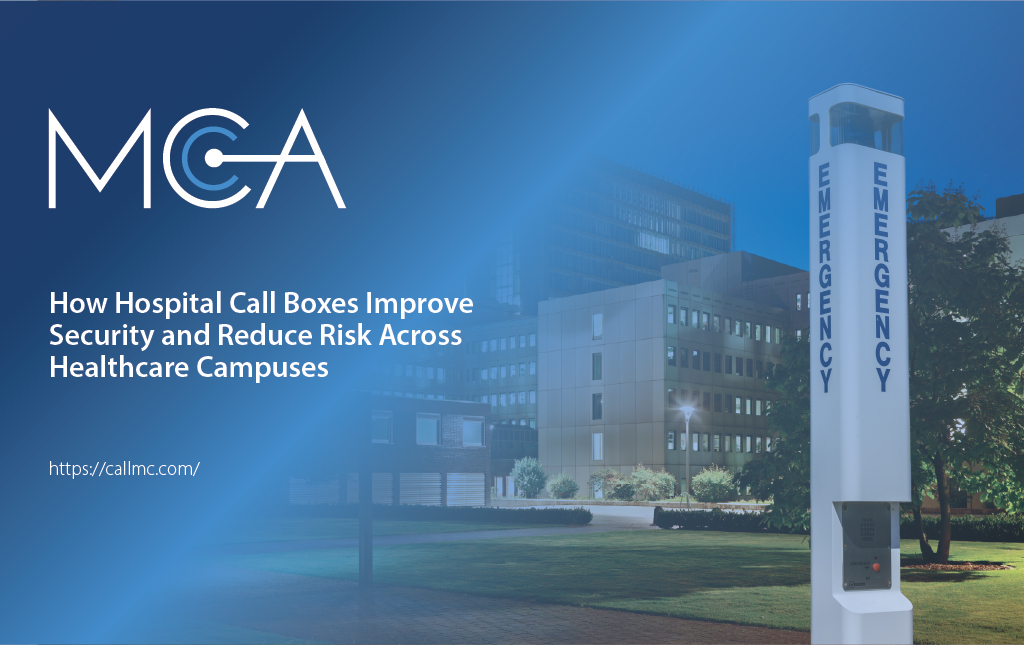
Emergency call boxes play a meaningful role in this strategy. By providing visible, reliable access to help across the campus, they help reduce risk, improve response coordination, and reinforce a proactive approach to safety.
Visibility as a Deterrent to Criminal Activity
Reducing Opportunity Through Environmental Design
Many security incidents are driven by opportunity. Areas that appear isolated, poorly monitored, or lacking visible safety infrastructure are more likely to attract unwanted behavior. This is especially true in hospital environments, where exterior spaces such as parking lots and garages can be large, busy, and difficult to monitor at all times.
Emergency call boxes change that equation. Their presence introduces a clear and visible layer of oversight. Even when unused, they signal that the area is monitored and that individuals have immediate access to assistance. This perception alone can discourage opportunistic incidents before they occur.
When combined with lighting, surveillance, and thoughtful campus design, call boxes become part of a broader strategy known as Crime Prevention Through Environmental Design (CPTED). Within that framework, visibility is not just a feature – iit is a tool for actively reducing risk.
Reinforcing Security Presence Without Increasing Staffing
Healthcare organizations often balance the need for stronger security with staffing and resource constraints. Increasing physical patrols across large campuses is not always practical or cost-effective.
Call boxes extend the perceived presence of security teams without requiring additional personnel. They act as fixed, visible touchpoints that reinforce coverage across the campus, helping organizations maintain a strong security posture more efficiently.
Reducing Liability Through Faster Response
The Cost of Delayed Response
In healthcare environments, delayed response can have serious consequences. Whether the situation involves a patient fall, a medical emergency, or a security concern, the time it takes to initiate and deliver assistance can directly impact outcomes.
From a risk perspective, delays can also increase liability. Questions about response time, access to help, and the adequacy of safety infrastructure are often central to post-incident evaluations. If individuals cannot easily access assistance, organizations may face increased scrutiny.
Emergency call boxes help address this by removing communication barriers. They provide immediate access to security teams, ensuring that incidents are reported quickly and that response efforts begin without delay.
Creating Documented Points of Access
Call boxes also contribute to a more structured and defensible safety environment. Their placement across campus creates clearly defined access points for emergency communication, demonstrating that the organization has taken steps to provide accessible support.
This can be an important factor in risk assessments, audits, and compliance reviews. It shows that safety infrastructure is not only present but strategically deployed to support response efforts.
Improving Security in High-Risk Areas
Parking Facilities and Exterior Spaces
Some of the highest-risk areas on a hospital campus are also the most difficult to manage. Parking lots and garages, in particular, present unique challenges. They are often expansive, operate around the clock, and experience fluctuating levels of activity throughout the day and night.
These environments can create conditions where individuals feel vulnerable, especially during early morning or overnight hours. They are also areas where incidents such as theft, accidents, or personal safety concerns are more likely to occur.
Emergency call boxes provide a direct line to assistance in these locations, ensuring that help is always within reach. Their visibility also reinforces a sense of oversight, helping to deter potential incidents.
Entrances, Walkways, and Remote Areas
Beyond parking areas, other exterior spaces can present similar risks. Walkways between buildings, secondary entrances, and remote facilities may not have the same level of consistent activity or monitoring as primary hospital areas.
Strategically placing call boxes in these locations helps create a more uniform safety environment across the entire campus. It ensures individuals have access to assistance regardless of where they are, reducing coverage gaps and improving overall security.
Strengthening Communication During Incidents
Direct Connection to Security Teams
One of the most important benefits of emergency call boxes is their ability to provide a direct, dedicated connection to security personnel. This eliminates the need for users to navigate complex systems or determine the appropriate contact point during an emergency.
Clear, two-way communication allows security teams to assess situations in real time, gather additional information, and provide guidance if needed. This improves both the speed and quality of response.
Integration with Broader Security Systems
Modern call box systems can also integrate with video surveillance, access control, and central monitoring platforms. When a call box is activated, nearby cameras can be triggered, providing immediate visual context.
This integration enhances situational awareness and allows security teams to respond more effectively. It also supports better documentation and analysis of incidents, contributing to ongoing improvements in safety strategy.
Supporting a Safer, More Accountable Environment
Demonstrating a Proactive Safety Approach
Healthcare organizations are expected to take a proactive approach to safety. This includes not only responding to incidents but also implementing measures that reduce risk and improve accessibility to help.
Emergency call boxes demonstrate that commitment. Their presence shows that the organization has invested in infrastructure designed to support safety across the entire campus, not just within clinical spaces.
Aligning with Compliance and Safety Expectations
While specific requirements may vary, many healthcare organizations operate under guidelines related to the environment of care, workplace safety, and emergency preparedness. Providing accessible communication points can support these broader objectives.
Call boxes align with these expectations by enabling individuals to quickly and easily request assistance, regardless of their location or circumstances.
A Practical Approach to Reducing Risk Across the Campus
Improving healthcare security is not about a single solution – it is about creating a system that works together to reduce risk, improve response, and support everyone on campus.
Emergency call boxes contribute to that system in practical, measurable ways. They deter unwanted activity, provide immediate access to help, and strengthen the organization’s overall safety infrastructure.
For healthcare leaders focused on risk management, operational efficiency, and patient and staff safety, call boxes offer a clear and effective way to enhance campus security while supporting broader organizational goals.
About MCA
We believe every workplace should be safe, secure, and efficient. As trusted advisors, we deliver integrated communication, connectivity, and security solutions with a Service First mindset – driven by a team that cares deeply about our customers and each other.
Why MCA? At MCA, we help solve critical communication, connectivity, and security challenges with turnkey, integrated system solutions – from two-way radios and in-building wireless to video surveillance, access control, and more. MCA is built from over 50 companies with deep technical expertise and strong local roots. And we’re still growing – expanding our capabilities, our reach, and our team.
Our 100+ Solution Centers bring together sales, installation, service, and customer operations teams to deliver seamless, nationwide support. Guided by our Service First value, we don’t just connect the wires and walk away – we provide customized solutions backed by deep expertise and lifecycle support.
