

How the 2025 Tornado Season Underscores the Urgency for Scalable, Reliable Alerting Systems
As of early April 2025, the United States has experienced over 470 tornadoes, nearly double the historical average for this time of year. With three major outbreaks between mid-March and early April and daily tornado activity reported for 12 consecutive days, this season is shaping up to be one of the most aggressive in modern history.
According to NOAA’s Storm Prediction Center, only two years in the past 16 have seen more tornadoes by this point: 2023 and 2017. Mississippi once again leads the nation in tornado reports, having experienced more than ten times its tornado count from the same period last year. Other states, like Missouri and Illinois, have also suffered devastating storms, with dozens of confirmed tornadoes causing widespread damage and long-term disruptions.
This rapidly intensifying trend stems from shifting climate patterns and seasonal anomalies, serving as a stark reminder that both rural and urban communities are highly vulnerable to fast-moving, destructive weather events. As tornadoes become more frequent, more powerful, and less predictable, the need for reliable, integrated, and scalable mass notification systems has never been more urgent.
The Warning System Gap: Technology Alone Isn’t Enough
Tornado alerts in the U.S. rely on a patchwork of technologies – text message alerts, broadcast systems, sirens, and weather apps – but these are not always accessible, particularly in rural areas with limited cell coverage or poor infrastructure. In cities, the challenge is different: individuals indoors or in noisy environments may not hear sirens or receive alerts in a timely manner.
A successful warning strategy requires a multi-layered communication infrastructure designed to alert, inform, and direct people quickly and clearly, regardless of geography, income level, or access to digital tools. Relying on a single point of failure, such as cell coverage or a tuned-in television, has proven insufficient during high-impact storms where every second counts.
A National Need for Scalable, Outdoor Mass Notification Systems
At MCA, we understand that no single technology can sufficiently warn every person during a natural disaster. We design and implement large-scale, integrated mass notification systems tailored to each community’s unique risk profile, population density, and environmental characteristics.
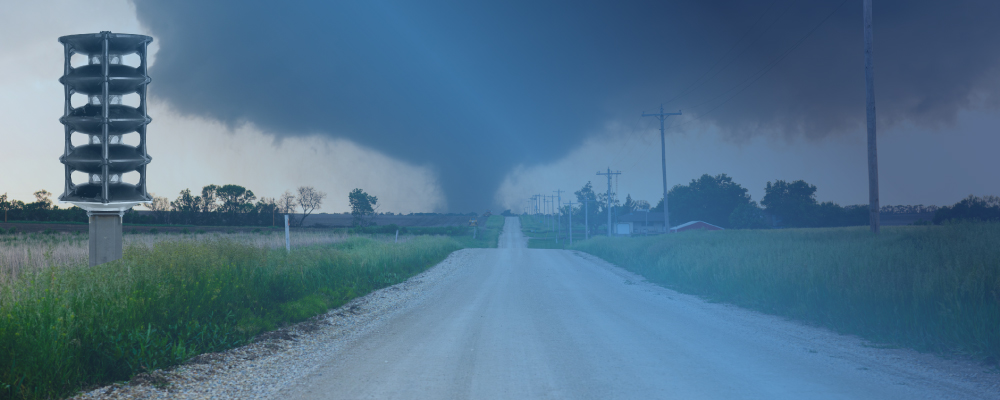
Our long-standing partnership with Whelen, a global leader in outdoor warning systems, enables us to provide solutions that deliver clear, wide-area audio alerts, some with ranges of up to 4 miles per tower, covering an area of up to 50 square miles. These systems are essential in rural areas with weak cell signals and serve as critical redundancy in urban environments, where overlapping technologies are necessary to ensure saturation.
In addition to these robust outdoor warning systems, MCA has developed a custom-built activation application, RapidWarn, to enhance response capabilities. RapidWarn allows emergency managers to activate alerts with precision and ease, offering tools such as polygon activation to target specific geographic areas. This ensures that alerts are sent only to impacted regions, reducing panic and providing accurate, localized messaging. RapidWarn integrates seamlessly with Whelen systems, emergency operations centers (EOCs), weather monitoring platforms, and other smart infrastructure tools, enabling both manual and automated activation based on storm proximity, public safety needs, or other critical events.
Whelen’s A.I.D.™ framework – Alert, Inform, Direct – further ensures that messaging is heard and understood. With MCA’s RapidWarn application, communities can depend on a scalable, intelligent solution for mass notification, ensuring lives are safeguarded when it matters most.
Next-Gen Detection: The Role of Infrasound in Early Tornado Warnings
As the industry advances, infrasound detection offers new hope for earlier warning systems. Unlike conventional radar, which detects tornadoes once they have formed, infrasound sensors can potentially detect the sub-audible acoustic signatures of tornado formation up to 20 minutes before touchdown.
Originally developed to monitor nuclear detonations, these sensors are now being adapted for tornado-prone areas, especially in regions with limited radar coverage. Integrating this technology into a larger mass notification strategy could extend warning times, allowing more people to reach shelter safely, particularly those in mobile homes, schools, large public venues, and healthcare facilities.
Building the Future of Tornado Resilience
Tornadoes aren’t just a seasonal threat – they present a national public safety issue requiring a coordinated and proactive response. At MCA, we believe that mass notification systems should be considered critical infrastructure, akin to electricity, water, and public safety radio networks.
We are working with local governments, school districts, healthcare networks, and enterprise customers to:
Assess and map vulnerability zones
Modernize legacy siren networks with IP-based alerting systems
Integrate new detection tools with multi-channel alert platforms
Provide real-time situational awareness through command and control applications
Tornado Resilience Is Community Resilience
With 2025 on track to become another record-breaking tornado year, the cost of inaction is too high. Communities need multimodal, multisensory notification systems built for modern threats—resilient enough to work during disasters, smart enough to reach people where they are, and scalable enough to grow with tomorrow’s technologies.
At MCA, we’re committed to helping public and private organizations protect lives, infrastructure, and operations by providing the systems, services, and support needed to stay ahead of every storm.
About MCA
MCA is one of the largest and most trusted warning system integrators in the United States, offering world-class voice, data, and security solutions that enhance the quality, safety, and productivity of customers, operations, and lives.
More than 65,000 customers trust MCA to provide carefully researched solutions for a safe, secure, and more efficient workplace. As your trusted advisor, we reduce the time and effort needed to research, install, and maintain the right solutions to make your workplace better.
Our team of certified professionals across the United States delivers a full suite of reliable technologies with a service-first approach. The MCA advantage is our extensive service portfolio to support the solution lifecycle from start to finish.
