
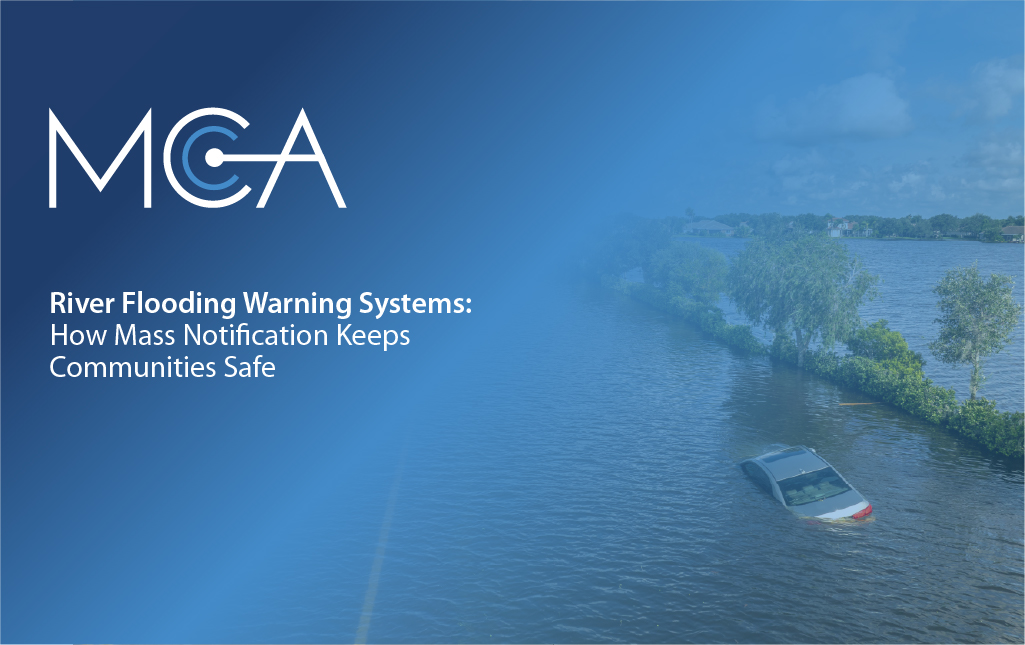
Flash floods are among the fastest-moving hazards a community will ever face. A river can rise from a trickle to a torrent in the time it takes for a storm to pass through, and by the time water is visible in the street, the window for a safe, orderly warning has often already closed. Tornadoes, wildfires, dam failures, high wind and hail, hazardous material releases, tsunamis, and lightning all carry the same lesson: the public needs to hear about danger before it arrives, not after.
That’s the problem mass notification systems are built to solve. Below is a look at how modern outdoor warning technology, remote flood monitoring, and a proven communications backbone come together to give agencies a faster, more reliable way to protect the people they serve.
The Fastest, Most Effective Way to Warn the Public
When it comes to warning people of a fast-developing hazard, one approach consistently outperforms the rest: sound a tone, then follow it with clear, intelligible voice instructions. Whelen calls this a three-step approach, A.I.D. — Alert, Inform, and Direct — and it’s designed to do the one thing a warning system exists to do: eliminate confusion, restore order, and save lives.
Each piece of that approach plays a distinct role:
- Sirens remain the most cost-effective way to warn a large area. Most people already recognize the tone, systems can be targeted at the population most at risk, and the control systems behind them tend to be the least complicated to operate.
- Outdoor voice warning adds a layer sirens alone can’t. It delivers timely notification to people already outdoors, doesn’t rely on the public knowing what a particular tone means, and gives operators the flexibility to speak directly to the people in harm’s way.
Used together, tone and voice turn a general alert into a specific, actionable direction.
Why the Technology Behind the Siren Matters
Not all sirens are built the same, and the difference shows up exactly when it matters most.
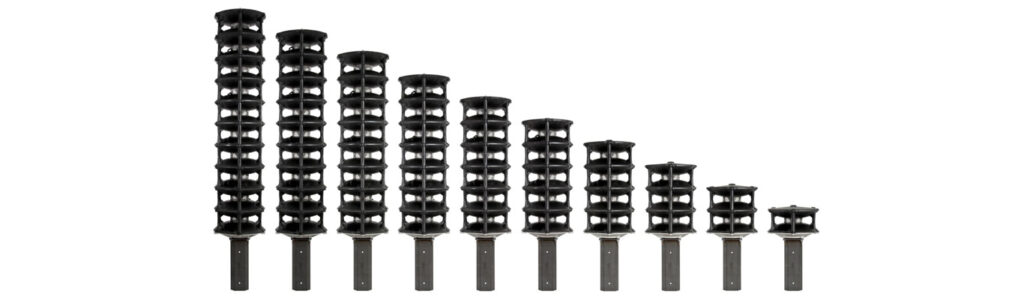
Whelen’s outdoor warning sirens are engineered specifically for this job. Their 400-watt low-frequency speaker driver is an exclusive design for outdoor warning applications, certified for a 20-year service life by the Government of Denmark, and built to be rugged and reliable in the field. Whelen’s 2900 series takes it a step further with a removable driver, so field maintenance doesn’t mean replacing an entire unit.
The frequency range matters too. Whelen uses low-frequency tones, in the 300–700 Hz range, because tones in that band cut through background noise and carry farther than higher-frequency alternatives. On the voice side, clarity is measured by the Speech Intelligibility Index (STI) — and it’s worth asking any manufacturer for their STI report, since that number is the real measure of whether instructions will actually be understood over distance and ambient noise.
Every Whelen siren ships as a fully manufactured, fully tested cabinet, built from either 5052 aluminum alloy or 304 stainless steel. And because Whelen manufactures every electronic assembly used in final assembly, the entire product line is genuinely manufactured in America — a single source for design and manufacturing, not an assembly of third-party parts.
Systems are also built to scale: standard warning tones include Wail, Alert, Hi/Lo, Attack, Air Horn, and Whoop, with omni-directional, high-power output ranging from 400W up to 4000W depending on site-specific needs.
Choosing the Right Communications Network
A siren is only as good as the network that controls it, and that’s where many agencies get stuck. Before deploying a siren solution, it’s worth evaluating the communications network against six criteria:
- Coverage — Is connectivity reliable across every site and every geography the system needs to reach?
- Capacity — Can the network handle the bandwidth and latency required for real-time monitoring and control?
- Cost — What does deployment and ongoing maintenance actually cost, and does it require building a new communications network from scratch?
- Control — Who manages the network, and how is access controlled?
- Capability — Does the system support future scalability and integration with other tools?
- Cybersecurity — What level of security does the network provide?
For many agencies, the answer is Motorola Solutions’ OptiWarn siren solution, which runs over an existing ASTRO IV&D network rather than requiring new infrastructure. That network is built to be reliable, secure, cost-effective, and centrally or distributedly managed, and it’s a certified, approved solution with dedicated spectrum — advantages that are hard to replicate by building a standalone system from the ground up.

OptiWarn gives operators several ways to activate a siren network: manually, based on environmental data; through pre-configured or on-the-fly siren groupings; automatically, using a National Weather Service feed; or on a fixed schedule for routine weekly or monthly testing. On the management side, it provides detailed reporting and event logging, diagnostics, and real-time siren status — down to communication path, driver and amp status, AC/DC voltage, and intrusion or tamper alerts.
From Warning Sirens to Real-Time Flood Monitoring
River flooding poses a challenge sirens alone can’t solve: agencies need to know a flood is developing before it’s severe enough to trigger an alert. That’s where the MC-EDGE siren controller and its supporting sensor network come in.

MC-EDGE is siren-agnostic and voice-capable, supporting live PA, digital voice messages, multi-tone alerts, and custom sequences, while also locally polling sirens for status or change-of-state conditions. For flood-specific monitoring, it connects to LoRa-based sensors — including level sensors, rain gauges, and hardwired ultrasonic level sensors — feeding data back through a LoRaWAN gateway. A single gateway can support more than 100 sensors, which makes it a cost-effective option for monitoring remote sites that would otherwise be difficult to reach.
That data feeds into a staged awareness model that gives operators room to respond before a full alert is warranted:
- Level 1 — Awareness: early indication that conditions are developing
- Level 2 — Warning: conditions have escalated and warrant attention
- Level 3 — Pending Activation: the system is prepared to trigger a public alert
- Level 4 — Auto-Activation: the system activates automatically based on defined thresholds
Operators can activate manually or let the system respond automatically once conditions cross a defined threshold, with optional weather-service activation and notification integration layered on top. Multiple OptiWarn systems can run over the same IV&D network, so agencies aren’t building a new communications backbone for every additional monitoring point they add.
A Real-World Example: Monitoring Pump Stations Without a New Network
One of the clearest illustrations of this approach in action comes from the Texas Department of Transportation (TxDOT).
The problem: A flooded underpass and an undetected pump station failure went unnoticed until a car attempted to drive through the flooded area. The incident made clear that TxDOT needed real-time monitoring to prevent it from happening again.
The challenge: TxDOT had a large number of pump stations spread across a wide area, and building a new radio network to monitor them would have been costly and time-consuming. Without SCADA or remote monitoring in place, maintenance staff had to physically check every station, making it difficult to prioritize work and hurting overall productivity.
The solution: Rather than build new infrastructure, TxDOT leveraged the existing Harris County ASTRO IV&D network — already private, resilient, and reliable — and deployed Motorola Solutions controllers with integrated IV&D radios. A centralized database and GUI now track pump station status and alarms in one place.
The result: TxDOT gained the coverage and reliability of an established IV&D system with rapid deployment and no new infrastructure to build, resulting in improved safety and far better operational visibility across every station.
Beyond Flooding: One Network, Many Use Cases
The same ASTRO IV&D network that supports siren activation and flood monitoring can carry a wide range of other monitoring functions for agencies that want to get more value out of a single communications backbone, including:
- Generator and hurricane shelter monitoring: running status, fail alarms, low fuel and fuel level, speed, and volt/amp readings
- Security monitoring: door, window, and gate intrusion detection with remote lock/unlock and open/close control
- Environmental monitoring: CO2, temperature, humidity, and barometric pressure via connected weather stations
- Lift station and fresh water monitoring: pump running status, fail alarms, high-level alarms, power and generator alarms, levels, flows, and rainfall
- Irrigation monitoring: level and gate control for irrigation systems
Because these systems all ride on the same countywide IV&D radio network, agencies can add monitoring points without standing up new infrastructure for each one.
Why Agencies Choose MCA for Mass Notification
Technology is only half the equation — deployment, service, and long-term support are what determine whether a system actually performs when it’s needed. Mobile Communications America (MCA) is built to handle all of it as a full-service, turnkey partner:
- Dedicated personnel and equipment for installation, service, and ongoing support
- Pre-sale product demonstrations, system design, and proposal preparation
- Full implementation support, including bucket and derrick trucks for pole installation and full-time installers
- Post-sale maintenance contracts backed by dedicated siren technicians
MCA is the largest Whelen master distributor in the world and a premiere partner with both Motorola Solutions and Whelen, giving agencies a single point of contact for design, installation, testing, maintenance, software, and hardware — rather than juggling multiple vendors for one system.
MCA maintains locations across Texas, including Arlington, Houston (3 locations), Austin, El Paso (2 locations), Lufkin, Odessa, Tyler, Corpus Christi, Georgetown, and San Antonio. A full list of locations is available at callmc.com/about/our-locations.
Get Your Flood Warning System Evaluated
River flooding doesn’t wait for a system to be ready. If your agency is relying on sirens without voice capability, monitoring pump stations by hand, or considering what it would take to build a new communications network from scratch, it’s worth a conversation before the next storm season, not during it.
Learn more at callmc.com/data-solutions/mass-notification-systems
Download Disaster Prep White paper
Download Disaster Prep Emergency Checklist
About MCA
Mobile Communications America (MCA) is a leading provider of wireless communications, mass notification, data, and security solutions, serving public safety agencies, utilities, education, healthcare, and business customers across the country. As the largest Whelen master distributor in the world and a premier partner with Motorola Solutions, MCA delivers a true turnkey offering — design, installation, testing, and maintenance — backed by dedicated technicians and local teams who know the communities they serve. Learn more at callmc.com.
