
How Nokia and the Ultra Ethernet Consortium Are Redefining Network Performance for AI and HPC Workloads
Definition: The Ultra Ethernet Consortium (UEC) unites technology leaders like Nokia to create next-generation Ethernet standards optimized for AI and high-performance computing (HPC) workloads.
The proliferation of Artificial Intelligence (AI) and High-Performance Computing (HPC) is fundamentally reshaping the architecture of modern data centers. These workloads demand a network infrastructure capable of unprecedented speed, reliability, and scale. Traditional Ethernet, while a versatile and ubiquitous standard, was not designed for the unique challenges posed by massive, parallel processing tasks. Recognizing this gap, industry leaders have collaborated to forge a new path forward.
MCA offers our customers a carefully researched portfolio of innovative voice, data, and security solutions. In line with this commitment, we partner with industry leaders like Nokia to bring proven, mission-critical technologies to our clients. This article explores the transformative impact of the Ultra Ethernet Consortium and how Nokia’s networking portfolio, sold and supported by MCA, is engineered to meet the future demands of AI data centers.
What is Ultra Ethernet Transport (UET) and Why Does It Matter?
Before delving into the consortium that created it, it is essential to understand the core technology: Ultra Ethernet Transport (UET). UET is a new transport layer protocol designed from the ground up to optimize network performance for the specific communication patterns of AI and HPC applications.
The primary goal of UET is to create a high-performance, lossless, and low-latency fabric that allows compute and storage resources to operate at maximum efficiency. It addresses the shortcomings of existing protocols in several key ways:
- Congestion Management: AI training jobs often involve “incast” scenarios, where many servers send data to a single destination simultaneously, causing congestion and packet loss. UET introduces advanced, sender-based congestion control mechanisms that react in microseconds to prevent bottlenecks and maintain smooth data flow.
- Multi-pathing and Load Balancing: UET enables traffic to be efficiently distributed across multiple network paths. This not only increases available bandwidth but also improves resilience, ensuring that the failure of a single link does not disrupt an entire job.
- Ultra-Low Latency: Even minor delays, known as “tail latency,” can significantly slow down tightly-coupled AI workloads. UET is engineered to minimize these delays, ensuring that all processing units receive data predictably and efficiently.
- Efficient Data Movement: UET incorporates capabilities like Remote Direct Memory Access (RDMA), allowing data to move directly between the network and application memory without software intervention. This drastically reduces CPU overhead and accelerates data transfers.
By solving these complex problems, UET provides a reliable and scalable foundation for the most demanding applications, ensuring that expensive compute resources are never left idle waiting for data.
The Ultra Ethernet Consortium (UEC): Standardizing Performance
The development of a technology as significant as UET required a collaborative, standards-driven approach. This led to the formation of the Ultra Ethernet Consortium (UEC).
The UEC is an industry-wide initiative, operating under the Linux Foundation, with a clear mission: to deliver a complete Ethernet-based communication stack optimized for AI and HPC. The consortium brings together a diverse set of stakeholders, including processor vendors, system builders, interconnect providers, and cloud operators, all working toward a common goal.
Goals of the UEC
- Optimize Ethernet: Enhance Ethernet with new functionality, performance, and developer-friendliness while minimizing changes to maintain interoperability.
- Exceed Specialized Technologies: Deliver a solution that surpasses the performance of today’s proprietary, specialized networking fabrics.
- Provide a Complete Architecture: Address technical challenges across multiple protocol layers, from the physical link to the software API, to ensure a cohesive and easily managed system.
- Promote an Open Ecosystem: Develop an open, interoperable standard that encourages competition and innovation, providing customers with a wide range of compliant hardware and software options.
With the release of UEC Specification 1.0, the consortium has defined the foundational standards for UET. This specification details the transport protocol, congestion control algorithms, security features, and physical layer enhancements needed to build the next generation of AI networks.
Nokia’s AI-Ready Portfolio: Proven for UEC Demand
Definition: Nokia’s 7220 IXR and 7250 IXR platforms are purpose-built switches and routers that exceed UEC Specification 1.0 performance metrics for AI and HPC networking.
Meeting the stringent requirements of UEC Specification 1.0 demands robust and forward-thinking hardware. Nokia, a key member of the UEC, has demonstrated that its portfolio of data center switches is engineered to meet and exceed these new standards.
Recent successful end-to-end testing of UET traffic across Nokia’s data center switching family validates the high performance, scalability, and reliability of their platforms for AI workloads. Let’s examine the solutions that make this possible.
What are the Nokia 7220 and 7250 Interconnect Routers?
The Nokia 7220 IXR and 7250 IXR series are high-capacity, fixed-configuration, and modular switching platforms that form the backbone of Nokia’s Data Center Fabric solution. They are designed explicitly for leaf-spine architectures in large-scale data centers and cloud environments.
Nokia 7220 Interconnect Router (IXR)
The 7220 IXR series provides high-density, fixed-configuration platforms that deliver the scale and flexibility required for modern data centers.
- High-Capacity Performance: With system capacities up to 51.2 Tb/s and support for port speeds from 1GE to 800GE, the 7220 IXR can handle the immense bandwidth demands of AI clusters.
- Resilient by Design: The platforms feature hot-swappable, redundant power supplies and fans, ensuring high availability for mission-critical operations.
- Open and Automated: Running the SR Linux Network Operating System (NOS), the 7220 IXR is built on a model-driven architecture that simplifies automation, enhances visibility, and allows for deep customization to meet specific operational needs.
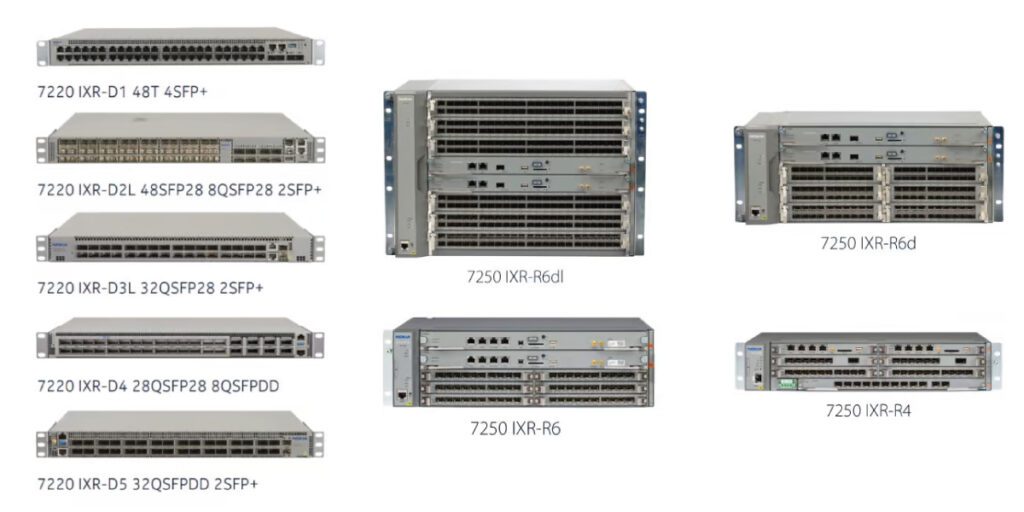
Nokia 7250 Interconnect Router (IXR)
The 7250 IXR series expands on this foundation with both modular and fixed platforms, offering even greater scale and versatility for the most demanding environments.
- Massive Scalability: The 7250 IXR delivers system capacities up to 460.8 Tb/s, providing the necessary throughput for massive AI and HPC deployments.
- Advanced Architecture: Its midplane-less, orthogonal direct cross-connect design ensures ultra-high reliability and low power consumption, while preparing the platform for future SERDES speed advancements.
- Investment Protection: The 7250 IXR supports both 800GE and 400GE coherent optics, including 400GE ZR+, providing flexible and future-proof connectivity options.
- Consistent Operations: Like the 7220 IXR, it runs the SR Linux NOS, enabling predictable, adaptable, and automated operations across the entire data center fabric.
By combining massive throughput, an open and extensible operating system, and a resilient hardware design, Nokia’s 7220 IXR and 7250 IXR platforms provide a proven foundation for building UEC-compliant networks. Their existing support for technologies like RoCEv2 and DCQCN already aligns with the principles of UET, offering customers an immediate path toward an AI-ready infrastructure.
Implementing UET with MCA and Nokia
As Rudy Hoebeke, Vice President of Software Product Management at Nokia, stated, “AI is changing the game when it comes to expected performance in AI data center networks… Nokia is a leader in this evolution, with one of the industry’s most robust portfolios for HPC/AI-ready data center networking.”
Navigating the transition to a new networking paradigm requires a partner with deep technical expertise and a proven track record. MCA’s Network Infrastructure Solutions (NIS) team is uniquely positioned to help data centers design, deploy, and manage UET solutions built on Nokia’s powerful portfolio. Our certified professionals collaborate with your teams to ensure a seamless integration that guarantees zero downtime and optimizes your infrastructure for the future of AI.
The Nokia 7220 IXR and 7250 IXR platforms are key components within MCA’s broader ecosystem of data center solutions. While this combination provides a powerful path to UEC compliance, our consultative approach ensures we identify the right fit for your specific operational requirements. Whether it’s this solution or another from our extensive partner network, MCA is committed to delivering the most reliable and efficient infrastructure to support your mission-critical goals.
Frequently Asked Questions
The UEC is an industry collaboration under the Linux Foundation that standardizes next-generation Ethernet technologies for AI and HPC applications, focusing on low latency and high throughput.
UET reduces latency, eliminates congestion, and supports multi-path traffic to ensure faster, lossless communication between compute and storage nodes, maximizing GPU and CPU utilization.
Nokia is a founding UEC member whose 7220 and 7250 IXR platforms have been validated for UET traffic, demonstrating industry-leading bandwidth, reliability, and automation.
Unlike standard Ethernet, UET adds AI-specific features like sender-based congestion control, microsecond feedback loops, and RDMA-style data movement for higher efficiency.
MCA’s Network Infrastructure Solutions team helps design, integrate, and support UET-ready networks using Nokia’s AI-optimized portfolio, ensuring scalability and zero downtime.
Yes. UET is built on Ethernet standards to preserve compatibility while enhancing performance, allowing organizations to upgrade incrementally.
About MCA
We believe every workplace should be safe, secure, and efficient. As trusted advisors, we deliver integrated communication, connectivity, and security solutions with a Service First mindset – driven by a team that cares deeply about our customers and each other.
Why MCA? At MCA, we help solve critical communication, connectivity, and security challenges with turnkey, integrated system solutions – from two-way radios and in-building wireless to video surveillance, access control, and more. MCA is built from over 50 companies with deep technical expertise and strong local roots. And we’re still growing – expanding our capabilities, our reach, and our team.
Our 100+ Solution Centers bring together sales, installation, service, and customer operations teams to deliver seamless, nationwide support. Guided by our Service First value, we don’t just connect the wires and walk away – we provide customized solutions backed by deep expertise and lifecycle support.
