
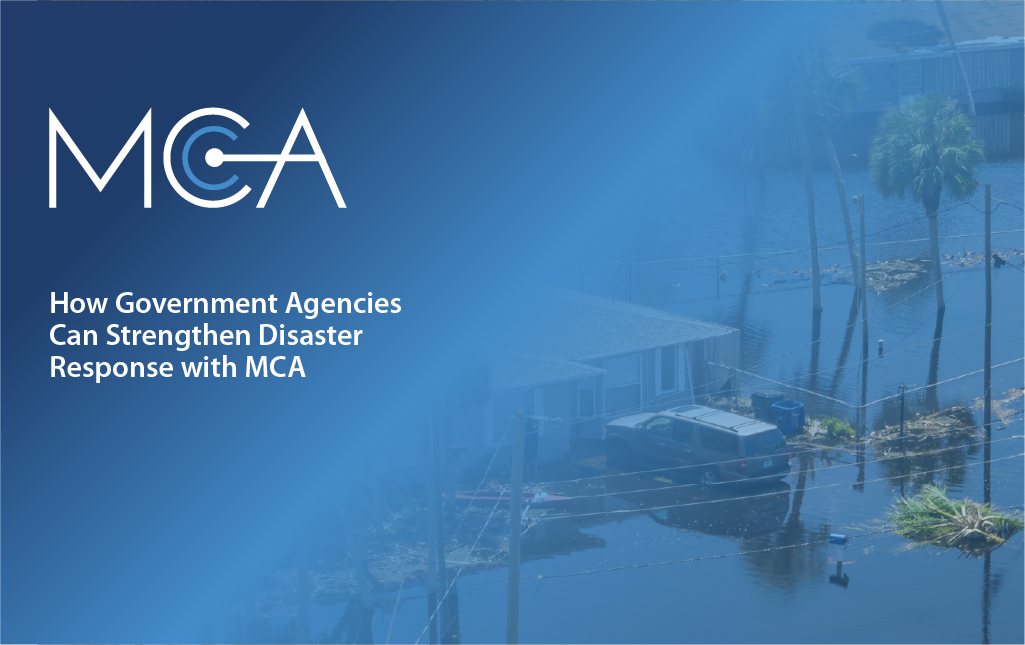
Combining Traditional Emergency Planning with Modern Technology for Faster Recovery
Every major disaster leaves the same three problems in its wake: damaged infrastructure, displaced people, and disrupted communication. For federal, state, and local agencies, the real test isn’t just responding fast — it’s responding fast and laying the groundwork for a full recovery at the same time.
Meeting that test takes two things working together: the traditional preparedness fundamentals agencies have relied on for decades, and the communications technology that keeps people connected when the grid, the towers, and the networks agencies normally count on go down. That combination is the foundation of MCA’s approach to disaster readiness, and it’s the difference between a response that stalls and one that keeps moving.
Why Disaster Impact Goes Beyond the Initial Event
Floods, tornadoes, wildfires, hurricanes, and landslides rarely give much warning, and the damage they cause doesn’t stop when the event itself is over. Homes, businesses, and public infrastructure can take years to rebuild, and the agencies managing that recovery are doing it while still responding to new needs on the ground.
Real preparedness has to account for both timelines at once: the emergency response happening in the first hours and days, and the long-term rebuilding effort that follows. Planning for one without the other leaves gaps that show up exactly when an agency can least afford them.
Start With the Fundamentals
Advanced technology gets a lot of attention, but it doesn’t replace the basics. Any solid disaster preparedness plan still needs to account for:
- Non-perishable food and water: Plan on roughly a gallon of water per person, per day, and account for both the affected population and the responders supporting them.
- Emergency shelter: Tents, portable toilets, and hygiene kits create a safe, sanitary environment for people who’ve been displaced.
- Medical readiness: Stocked first-aid supplies and access to medications for chronic conditions, such as insulin or inhalers, are essential for a population that can’t simply visit a pharmacy.
- A clear chain of command: Defined ownership over logistics, medical care, and communication keeps critical tasks from falling through the cracks during a crisis.
None of this is flashy, but it’s the foundation everything else builds on. On its own, though, it’s no longer enough to meet what modern disasters demand.
Where Modern Disasters Outpace Traditional Planning
Infrastructure damage doesn’t just affect roads and buildings — it can take out cell service, internet access, and radio towers in the same event, cutting off first responders from each other and from the public they’re trying to help. When that happens, an agency’s entire response can grind to a halt at the exact moment it needs to move fastest.
That’s the gap MCA’s technology-forward strategy is built to close, using the PACE framework — Primary, Alternate, Contingency, Emergency — as its structure. The idea behind PACE is simple: build in enough redundancy that when one communication path fails, another is already in place to take over, without forcing responders to improvise in the middle of a crisis.
Here’s how each layer works:
- Primary: Two-way radios and broadband network infrastructure built for both everyday operations and emergency use.
- Alternate: Interoperable LTE radios and cellular routers with automatic carrier switching, ready to take over the moment primary systems falter.
- Contingency: Mobile repeaters, mass notification trailers, and portable antennas that extend communications into remote or hard-hit areas.
- Emergency: Satellite communications and portable network systems that provide connectivity as a last resort, even when every other network is down.
The Tools That Make PACE Work in the Field
A framework is only as good as the equipment behind it. MCA equips agencies with tools built specifically for field conditions:
- Rugged public-safety radios, engineered to deliver clear communication in extreme weather and high-stress conditions.
- Grab-and-go communication kits, compact enough to deploy instantly and equipped with repeaters and antennas for immediate field coverage.
- Portable cellular and Wi-Fi hubs, capable of supporting hundreds of connected devices with 4G/5G connectivity and optional satellite backup.
- Self-sustaining surveillance trailers, providing round-the-clock, high-definition monitoring and Wi-Fi at relief sites.
- Mass notification systems, both fixed and portable, capable of broadcasting emergency alerts across large areas in real time.
Proven in the Field, Not Just on Paper
This isn’t theoretical. When a federal agency responded to a major earthquake, MCA’s radio kits helped establish a mile-wide communications network in roughly 90 minutes — fast enough to matter in the window when speed determines outcomes.
The pattern repeats across different disaster types. Portable cellular hubs helped emergency management teams stay coordinated during hurricane recovery efforts and widespread power outages. In coastal communities, fixed mass notification systems gave residents the advance warning they needed to evacuate safely before a storm made landfall.
Preparation Is What Buys Agencies Time
The agencies that recover fastest are the ones that were ready before the disaster hit — not the ones scrambling to adapt once it did. That means pairing the fundamentals, food, water, shelter, and a clear chain of command, with the layered communications technology that keeps coordination intact when conditions are at their worst.
MCA partners with agencies at every level of government to build exactly that kind of readiness, backed by decades of experience supporting the full lifecycle of disaster preparedness, response, and recovery.
Ready to see how a layered communications strategy would hold up in your agency’s own disaster scenarios? Get in touch with MCA to start the conversation.
Download Disaster Prep White paper
Download Disaster Prep Emergency Checklist
About MCA
MCA is one of the largest and most trusted integrators in the United States, offering world-class voice, data, and security solutions that enhance the quality, safety, and productivity of customers, operations, and lives. More than 65,000 customers trust MCA to provide carefully researched solutions for a safe, secure, and more efficient workplace. As your trusted advisor, MCA reduces the time and effort needed to research, install, and maintain the right solutions to make your workplace better.
MCA’s team of certified professionals across the United States delivers a full suite of reliable technologies with a service-first approach, supporting the entire solution lifecycle from design through long-term maintenance.
