
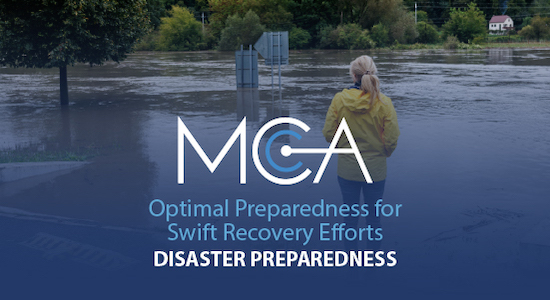
Combining Traditional Emergency Planning with Cutting-Edge Tech for Faster Disaster Recovery
When natural disasters strike, they often leave behind a trail of destruction—damaged infrastructure, displaced communities, and disrupted lives. For federal, state, and local agencies, these events present an enormous challenge: how do you respond quickly and effectively while laying the groundwork for a full recovery?
The key lies in a two-fold strategy that combines traditional preparedness tactics with cutting-edge technology. As outlined in MCA’s comprehensive whitepaper, Optimal Preparedness for Swift Recovery Efforts, disaster readiness is not just about stockpiling supplies – it’s about ensuring seamless communication, coordination, and security throughout every emergency phase.
Understanding the Real-World Impact of Disasters
Floods, tornadoes, wildfires, hurricanes, and landslides can strike with little warning, causing widespread damage that affects homes, businesses, and public infrastructure. These events don’t just disrupt the present—they also reshape the future of communities, often requiring years of recovery.
Effective disaster preparedness starts with understanding the full scope of these impacts and taking proactive steps to mitigate them. This involves planning for short-term emergency response as well as long-term community rebuilding.
The Foundation: Traditional Disaster Preparedness
Before diving into high-tech solutions, let’s not overlook the basics. MCA emphasizes the importance of traditional preparedness strategies like:
- Stockpiling non-perishable food and water: A gallon of water per person per day is a baseline, and agencies must plan for both the affected population and emergency responders.
- Providing emergency shelter: Durable tents, portable toilets, and hygiene kits create a safe, sanitary environment for those displaced.
- Maintaining medical readiness: Stocked first-aid kits and access to medications for chronic conditions (like insulin or inhalers) are essential.
- Creating a clear chain of command: Knowing who is responsible for logistics, medical care, and communication ensures nothing falls through the cracks during a crisis.
These supplies and strategies may not be flashy, but they are lifesaving. However, in today’s world, they’re not enough alone.
Modern Challenges Require Modern Solutions
As critical as traditional approaches are, modern disaster scenarios demand a technological edge. Infrastructure damage can knock out cell service, internet, and radio towers—cutting off first responders from one another and the public.
That’s why MCA advocates for a technology-forward preparedness strategy, centered on the PACE communication framework (Primary, Alternate, Contingency, Emergency). This layered approach ensures that when one system fails, others can immediately take its place.
Here’s how MCA supports each layer:
- Primary: MCA’s two-way radios, broadband networks, and robust infrastructure are designed for everyday and emergency communication.
- Alternate: Interoperable LTE radios and cellular routers with automatic carrier switching kick in when primary systems falter.
- Contingency: Mobile repeaters, mass notification trailers, and portable antennas expand communications into hard-hit or remote areas.
- Emergency: Satellite communications and TRaCK Box systems provide last-resort connectivity, even when all other networks are down.
Powerful Tools in the Field
MCA offers an arsenal of tactical tools to aid agencies before, during, and after a disaster:
- Motorola APX Radios: Built for rugged environments, these radios ensure crystal-clear communication even during the worst weather events.
- CompassRespond Grab-and-Go Kits: Compact and easy to deploy, these kits come with repeaters and antennas for instant field communication.
- TRaCK Box Systems: These mobile cellular/Wi-Fi hubs can support up to 256 devices and include 4G/5G capabilities, plus optional satellite links.
- Surveillance Trailers: Offering 24/7 security at relief sites, these self-sustaining trailers provide high-definition monitoring and Wi-Fi broadcasting.
- Mass Notification Systems: Fixed installations and portable trailers broadcast emergency alerts across large areas, informing residents and first responders in real time.
Real-World Results
MCA’s technology isn’t just theoretical, it’s been tested and proven in emergencies. When a federal agency responded to a devastating earthquake, MCA’s radio kits enabled them to establish a mile-wide communication network in just 90 minutes.
During hurricane recovery efforts in North Carolina and widespread power outages in New Mexico, TRaCK Box systems helped emergency management teams stay connected and coordinated. In coastal towns, fixed mass notification systems warned residents of incoming storms, giving them the precious time to evacuate safely.
The Bottom Line: Proactive Preparation Saves Lives
The more prepared agencies are before a disaster, the faster they can respond and recover when one occurs. This means combining the essentials—like food, water, and shelter—with next-generation tools that enable seamless coordination and real-time communication.
MCA stands ready to partner with agencies across all levels of government to deliver these solutions. With decades of experience and a service-first mindset, MCA supports you through the full lifecycle of disaster preparedness, response, and recovery.
Optimal Preparedness for Swift Recovery Efforts to explore the complete strategies, technologies, and real-world case studies that can transform your disaster response capabilities.
Discover how MCA helps agencies like yours build more resilient communities, reduce disaster recovery times, and save lives when it matters most.
About MCA
MCA is one of the largest and most trusted integrators in the United States, offering world-class voice, data, and security solutions that enhance the quality, safety, and productivity of customers, operations, and lives. More than 65,000 customers trust MCA to provide carefully researched solutions for a safe, secure, and more efficient workplace. As your trusted advisor, we reduce the time and effort needed to research, install, and maintain the right solutions to make your workplace better.
Our team of certified professionals across the United States delivers a full suite of reliable technologies with a service-first approach. The MCA advantage is our extensive service portfolio to support the solution lifecycle from start to finish.
