
The ADXV Series DAS: Scalable Distributed Antenna Solutions from ADRF and MCA
Modern buildings create complex RF challenges that demand sophisticated solutions. Steel reinforced structures, energy-efficient glazing, and dense construction materials form natural barriers to cellular signals, creating dead zones that compromise communications when reliability matters most. The ADRF ADXV Series Distributed Antenna System delivers comprehensive wireless coverage solutions that scale from intimate zones to massive venues while supporting both commercial mobility and public safety communications through a unified, future-ready architecture.
What is the ADRF ADXV Series DAS?
The ADXV Series represents ADRF’s flagship optical distribution system that covers the complete spectrum of power levels for indoor and outdoor applications. This modular, fiber-fed distributed antenna system transports frequencies from VHF through 4 GHz regardless of protocol or modulation, enabling single-system architectures that serve LTE, 5G NR, and public safety communications simultaneously.
MCA’s partnership with Advanced RF Technologies enables us to deliver these sophisticated distributed antenna solutions with comprehensive engineering support and lifecycle services. Our collaborative approach ensures optimal system design, professional implementation, and ongoing performance optimization across diverse facility types and operational requirements.
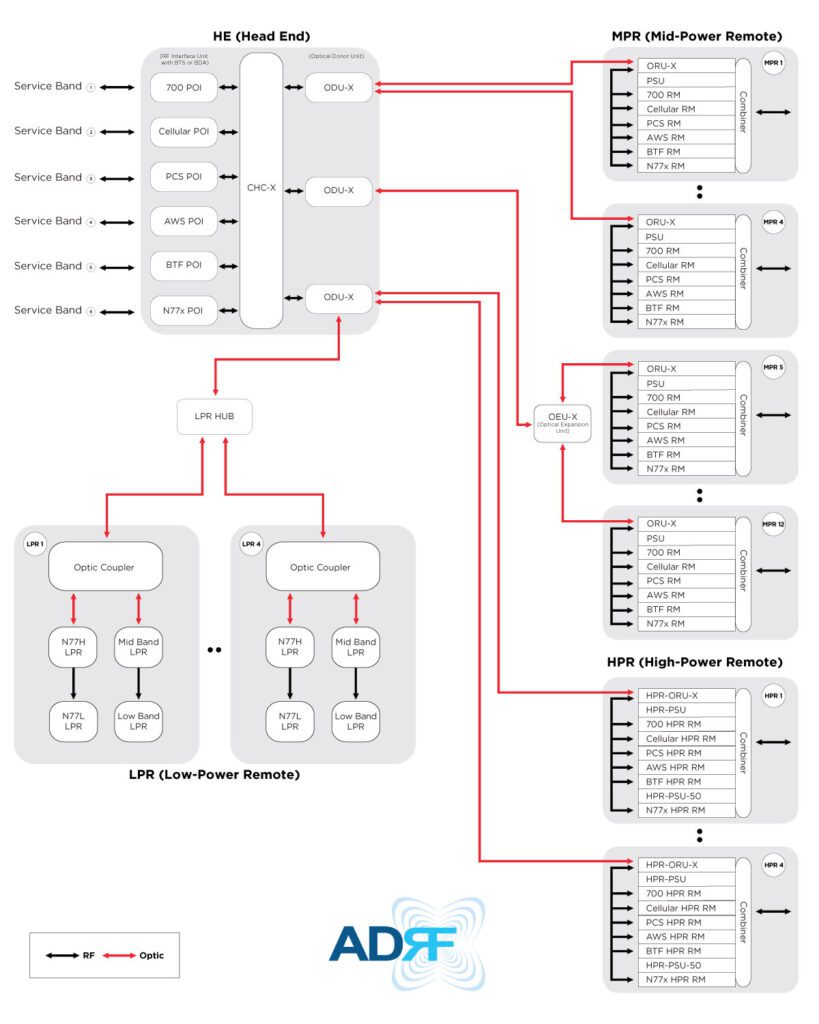
The ADXV platform centers on a carrier-grade architecture that interfaces directly with base stations or bi-directional amplifiers at the Head End, then distributes RF signals over single-mode fiber to strategically positioned remote units throughout coverage areas. This fiber-to-the-edge approach minimizes signal loss while providing the scalability necessary for complex multi-zone deployments.
Revolutionary System Architecture
Head End Excellence and Capabilities
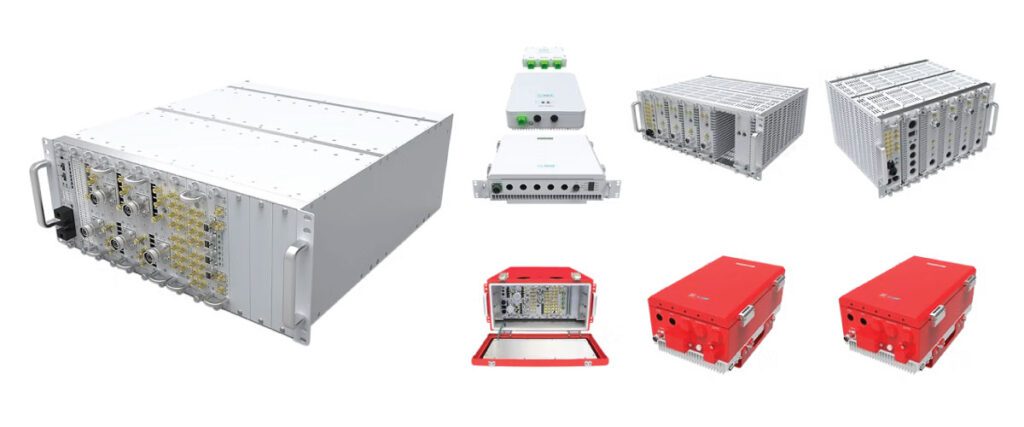
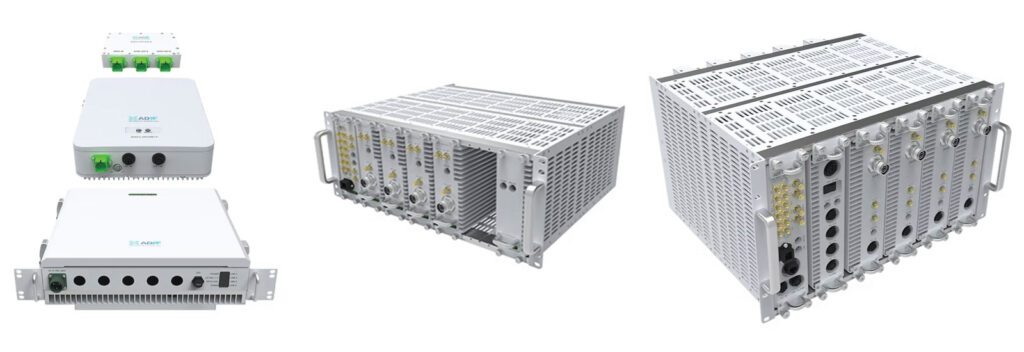
The ADXV Head End serves as the intelligent command center that orchestrates signal distribution across entire facilities. Supporting up to 12 modules in standard 19-inch rack configurations, with specialized variants accommodating up to 10 modules for NEMA 4 outdoor deployments, these systems provide exceptional flexibility for diverse installation environments.
Advanced daisy-chaining capabilities enable up to 15 Head End units to operate cohesively through Ethernet connectivity, creating massive distributed networks suitable for airport terminals, hospital complexes, and sprawling campus environments. This scalability ensures seamless coverage expansion without architectural limitations.
Integrated Intelligence Features:
- Built-in CW generator for precise signal testing and calibration
- Comprehensive spectrum analyzer providing real-time RF environment assessment
- Programmable power sharing optimizing signal distribution efficiency
- Noise and channel power level detection ensuring optimal performance
- Direct BTS interface supporting up to 48 dBm input per Point of Interface card
- Automatic Level Control maintaining user-defined signal parameters
- System-wide firmware update capability from centralized Head End management
The Head End’s Point of Interface modules accommodate diverse carrier requirements, supporting direct connections to base station equipment while providing the signal conditioning necessary for optimal fiber transport. Channel combiner units enable efficient spectrum utilization, while optical donor units manage fiber distribution to remote locations throughout coverage areas.
Remote monitoring and control capabilities leverage ADRF’s intuitive web-based graphical user interface, providing comprehensive system visibility without requiring specialized third-party software. Dry contact alarming and SNMP v1, v2c, and v3 protocol support ensure seamless integration with existing network management systems and building automation platforms.
Comprehensive Frequency Coverage
The ADXV platform supports an extensive frequency portfolio that addresses both current operational requirements and future technology evolution. This comprehensive band support includes 600 MHz, 700 MHz with FirstNet Band 14, 700 APT, Cellular and SMR 800, PCS, AWS, WCS, BRS for both TD-LTE and FDD-LTE applications, C-Band for 5G NR services, and specialized Department of Defense spectrum allocations.
This frequency flexibility enables unified system architectures that serve commercial 4G and 5G services alongside mission-critical public safety communications, eliminating the complexity and cost associated with separate infrastructure deployments for different service categories.
Modular Remote Unit Portfolio
Low-Power Remote Units (LPR)
Low-Power Remote Units excel in fiber-to-the-edge deployments where coverage zones require precise signal distribution without excessive power levels. These compact units support band-specific modules delivering 17, 20, or 23 dBm composite downlink output while maintaining IP66 environmental ratings without additional protective enclosures.
The LPR architecture leverages optical hub connectivity that powers and feeds up to eight primary units, with optical couplers enabling single fiber strands to serve two primaries, optimizing fiber utilization across complex installations. This design proves particularly effective for hotels, office buildings, and retail environments where numerous small coverage zones require individual attention.
LPR Component Specifications:
- High-Band (N77H): MIMO configuration, 23 dBm per band primary units
- High-Band (N77L): MIMO configuration, 23 dBm per band secondary units
- Mid-Band Coverage: PCS, AWS-1/3, WCS, BRS support with SISO configuration, 20 dBm per band
- Low-Band Coverage: 600 MHz, 700 FirstNet, 800 SMR with SISO configuration, 17 dBm per band
The modular approach enables precise coverage tailoring while the optical coupler system provides deployment flexibility that accommodates complex architectural constraints common in modern building designs.
Mid-Power Remote Units (MPR)
Mid-Power Remote Units address medium-sized coverage zones typical in hospitals, educational facilities, and corporate campus environments. Supporting up to seven remote modules within 4U rack configurations, these systems provide the performance headroom necessary for environments with moderate to high user densities.
Built-in spectrum analyzer capabilities enable real-time RF environment monitoring, while system-wide commissioning to user-defined levels ensures consistent performance across all coverage areas. The 30 dB test ports on each module facilitate rapid verification and troubleshooting, while PIM-rated 4.3-10 connectors ensure signal integrity throughout the distribution network.
Local Ethernet interfaces provide independent management access, enabling zone-specific optimization without affecting overall system operation. Band-specific amplifier modules are available in 2W and 5W variants, with optional 1.5U expansion racks accommodating additional modules as coverage requirements evolve.
The automatic level control system maintains output RF power at user-specified values while noise and channel power level detection provide continuous performance validation. This intelligent management ensures optimal coverage while protecting against interference and signal degradation.
High-Power Remote Units (HPR)
High-Power Remote Units deliver the substantial RF output necessary for large coverage zones, outdoor sectors, and venues where long coax runs or significant penetration loss demand maximum signal strength. Supporting up to six modules within 6U rack configurations, these systems provide comprehensive coverage capabilities for stadiums, airports, and major venues.
Integrated spectrum analyzer functionality enables detailed RF environment assessment, while 40 dB test ports on each module provide enhanced measurement capabilities for complex troubleshooting and optimization procedures. Band-specific modules are available in 20W and 40W configurations, delivering the power levels necessary for challenging coverage scenarios.
Local Ethernet access ensures independent management capabilities, while optional pole-mount kits extend placement flexibility for outdoor applications and specialized installations. The robust mechanical design accommodates harsh environmental conditions while maintaining the precision RF performance essential for demanding applications.
HPR Technical Capabilities:
- Support for up to six remote modules in standard rack configurations
- Built-in spectrum analysis providing detailed RF environment monitoring
- System-wide commissioning capabilities ensuring consistent coverage
- Optional expansion racks supporting additional module requirements
- Automatic Level Control maintaining optimal signal parameters
- PIM-rated connectors ensuring signal integrity throughout distribution
Public Safety DAS Solutions
Comprehensive Public Safety Integration
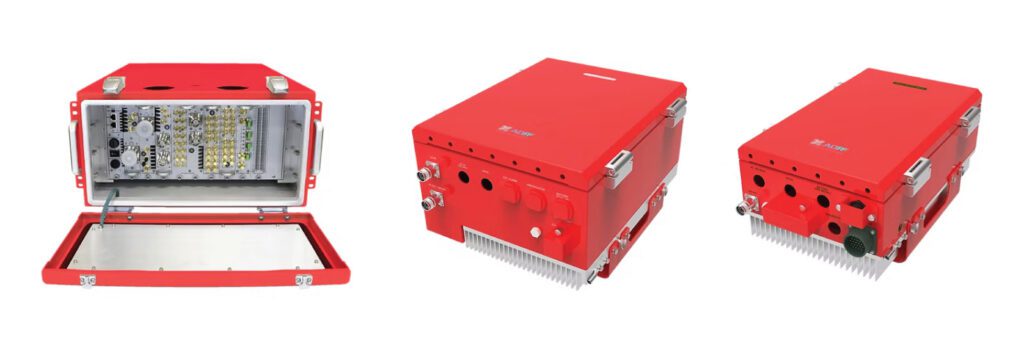
The ADXV platform’s public safety capabilities pair commercial-grade manageability with life-safety compliance requirements, ensuring reliable first responder communications while maintaining the operational simplicity essential for emergency situations. Public safety variants incorporate specialized features including enhanced environmental protection, battery backup support, and comprehensive alarm integration.
The 700/800 MHz Public Safety Remote delivers 33 dBm composite downlink output while supporting FirstNet Band 14 and traditional public safety frequencies. Built-in spectrum analyzer capabilities provide real-time RF monitoring, while dry contact alarming ensures immediate notification of any condition that could compromise emergency communications reliability.
ADXV-R-3378P-U Specifications
The ADXV-R-3378P-U (which is also a supporting component of ADRF’s FiRe Series) represents the pinnacle of public safety fiber remote technology, providing comprehensive coverage for PS700 (including Band 14) and PS800 frequencies. This UL 2524 Second Edition certified unit delivers 33 dBm composite downlink output while maintaining Type 4/NEMA 4 weather resistance for challenging installation environments.
Technical Performance:
- Frequency Coverage: PS700 758-768 MHz DL / 788-798 MHz UL, 769-775 MHz DL / 799-805 MHz UL; PS800 851-861 MHz DL / 806-816 MHz UL
- Input Power Range: -62 to -20 dBm from FiRe-78-8-U Head End
- Gain Specifications: 32-57 dB downlink, -4 to 36 dB uplink
- Noise Figure: ≤5 dB at maximum gain center frequency
- Environmental Protection: Type 4/NEMA 4 rated enclosure
- Operating Temperature: -22°F to 131°F (-30°C to 55°C)
- Power Requirements: 110-240 VAC with battery backup functionality
The system supports up to two PSR-ANN-L annunciators providing visual and audible alarm indication compliant with NFPA 1, 72, 1221, and 1225 standards alongside International Fire Code requirements. Comprehensive dry contact alarming covers antenna system integrity, amplifier operation, power supply status, and battery condition.
VHF/UHF Public Safety Coverage
Jurisdictions requiring VHF fire or UHF police services benefit from dedicated public safety remote units delivering 25 dBm composite output across VHF (138-174 MHz) and UHF (380-512 MHz) frequency ranges. These specialized units incorporate bandpass filtering and multiplexer capabilities that minimize interference while ensuring reliable emergency communications.
The Public Safety Head End maintains NEMA 4 environmental rating while supporting up to 10 modules, comprehensive battery backup systems, and SNMP monitoring capabilities. This configuration ensures reliable operation during extended power outages while providing the network-level visibility essential for emergency operations center integration.
Advanced Management and Commissioning
Auto Commissioning Routine™
ADRF’s proprietary Auto Commissioning Routine represents a significant advancement in DAS deployment efficiency, utilizing integrated spectrum analyzers and signal generators to accelerate system commissioning and optimization procedures. This intelligent automation reduces commissioning time while ensuring optimal performance across all coverage zones.
The web-based GUI provides comprehensive remote monitoring and troubleshooting capabilities without requiring specialized third-party software or extensive training programs. System administrators can access real-time performance data, adjust operational parameters, and diagnose potential issues from any network-connected device.
Comprehensive Alarm Integration
System-wide alarm capabilities provide immediate notification of conditions that could compromise coverage or compliance requirements. Dry contact alarming integrates seamlessly with existing building management systems, while SNMP trap functionality ensures network management system integration for enterprise-scale deployments.
The alarm system monitors antenna integrity, amplifier performance, power supply operation, battery condition, and charging system status. This comprehensive monitoring ensures immediate identification of potential issues before they can impact emergency communications reliability.
Strategic Applications Across Industries
Healthcare and Critical Infrastructure
Healthcare facilities present unique challenges where emergency communications must coexist with sensitive medical equipment while meeting stringent regulatory requirements. The ADXV platform’s channelized filtering capabilities and precise frequency control eliminate potential interference with medical devices while providing robust public safety coverage essential for emergency response operations.
Critical infrastructure applications including data centers, utility facilities, and transportation hubs require specialized solutions that accommodate unique security requirements and operational constraints. Our collaborative approach with facility management ensures ADXV deployments meet all operational requirements while maintaining superior installation quality and system reliability.
Educational and Government Facilities
Educational institutions and government facilities face evolving public safety requirements demanding comprehensive emergency communications capabilities. The ADXV Series provides scalable solutions accommodating diverse facility sizes and operational requirements while ensuring compliance with federal, state, and local emergency communication mandates.
Campus environments benefit from fiber-based architecture enabling cost-effective coverage extension across multiple buildings while maintaining centralized management capabilities. Multi-building deployments leverage daisy-chained Head End configurations that provide unified system oversight without compromising individual building optimization.
Large Venues and Entertainment Facilities
Sports stadiums, convention centers, and entertainment venues require high-capacity solutions that accommodate peak occupancy scenarios while ensuring emergency communications remain reliable during high-demand situations. High-Power Remote units provide the substantial RF output necessary for comprehensive coverage throughout these challenging environments.
Outdoor applications benefit from optional pole-mount configurations and enhanced environmental protection ensuring reliable operation regardless of weather conditions. The modular architecture enables coverage optimization for different venue areas while maintaining centralized management and monitoring capabilities.
Commercial Real Estate and Corporate Campuses
High-rise office buildings and corporate campus environments require reliable coverage that supports both daily operations and emergency response capabilities. The ADXV platform’s scalable architecture accommodates diverse building types while providing the reliability guarantees essential for professional environments.
Mid-Power Remote units prove particularly effective for typical office environments, delivering appropriate coverage levels without excessive power consumption or infrastructure complexity. The fiber-to-the-edge approach minimizes feeder loss while enabling coverage optimization for specific floor plans and usage patterns.
Investment Protection and Future Readiness
Modular Architecture Benefits
The card-based design philosophy enables cost-optimized initial deployments that accommodate organic growth without disruptive system replacement. New carriers or frequency bands integrate seamlessly with existing infrastructure, protecting initial investments while providing pathways for technology evolution.
This pay-as-you-grow approach proves particularly valuable for facilities experiencing expansion or modification, as existing ADXV infrastructure provides the foundation for cost-effective enhancement while maintaining full regulatory compliance and operational reliability.
5G and Advanced Technology Support
Native support for C-Band frequencies and 5G NR protocols ensures compatibility with emerging cellular technologies while the broad frequency coverage accommodates diverse carrier requirements. Department of Defense spectrum support proves valuable for federal facilities with mixed commercial and government communication requirements.
The platform’s protocol-agnostic design enables support for both FDD-LTE and TD-LTE applications alongside emerging 5G services, ensuring long-term viability as cellular technologies continue advancing toward enhanced mobile broadband and mission-critical communication services.
Professional Partnership Excellence
MCA’s Comprehensive Service Portfolio
MCA’s collaboration with ADRF extends beyond equipment provision to include expert consultation, professional design services, and comprehensive lifecycle support. Our certified engineering teams possess extensive experience across diverse facility types and regulatory environments, ensuring optimal solution design and flawless implementation.
Our service portfolio encompasses facility assessment, RF propagation modeling, system design optimization, professional installation coordination, commissioning support, and ongoing maintenance services. This comprehensive approach ensures maximum system performance while minimizing total cost of ownership through strategic planning and proactive maintenance.
NEBS Level 3 Reliability and Supply Chain Excellence
Carrier-grade NEBS Level 3 compliance ensures the exceptional reliability standards essential for mission-critical applications while ADRF’s vertically integrated supply chain delivers industry-leading lead times that support demanding project schedules.
Our technical support capabilities include comprehensive engineering assistance, rapid response troubleshooting, and proactive system monitoring ensuring continuous optimal performance. This commitment to service excellence provides confidence that critical communications infrastructure will perform reliably when needed most.
Choosing the Right DAS Solution
The ADRF ADXV Series represents one solution set within MCA’s comprehensive portfolio of distributed antenna solutions. Our expert teams conduct thorough assessments of specific facility requirements, operational constraints, and regulatory obligations to determine whether the ADXV Series provides the optimal solution or if alternative technologies would better address unique challenges.
This consultative approach ensures every client receives the most effective solution for their specific requirements while optimizing investment efficiency and long-term operational success. Our commitment to solution excellence means recommending the best technology for each application while providing the professional support necessary for sustained success.
The ADXV Series delivers comprehensive distributed antenna capabilities that unify commercial and public safety communications within scalable, future-ready architectures. Through fiber-to-the-edge distribution, multiple remote power tiers, extensive frequency support, and carrier-grade reliability, these systems provide dependable foundations for venues that cannot afford coverage gaps or communication failures.
Contact MCA today to explore how the ADRF ADXV Series can enhance your facility’s wireless infrastructure. Our certified professionals will conduct comprehensive assessments of your specific requirements and design tailored solutions ensuring optimal coverage while supporting continued operational excellence and technology advancement.
About MCA
MCA is one of the largest and most trusted technology integrators in the United States, offering world-class voice, data, and security solutions that enhance the quality, safety, and productivity of customers, operations, and lives.
More than 65,000 customers trust MCA to provide carefully researched solutions for a safe, secure, and more efficient workplace. As your trusted advisor, we reduce the time and effort needed to research, install, and maintain the right solutions to make your workplace better.
Our team of certified professionals across the United States delivers a full suite of reliable technologies with a service-first approach. The MCA advantage is our extensive service portfolio to support the solution lifecycle from start to finish.
