

What Is An Emergency Responder Communications Enhancement System?
ERCES solutions, sometimes referred to as Public Safety BDA-DAS or ERRCS solutions, denotes the radio frequencies (RF) that first responders (Fire, EMS, and Law Enforcement Agencies) use to communicate in the field while responding to emergency calls. Public safety officials transmit signals on specific frequencies mandated by the FCC. However, these signals can sometimes fail to penetrate buildings, particularly new constructions with LEED certification that use low-E glass windows, which can attenuate radio signals.
In these situations, building owners may be required to install a Public Safety Distributed Antenna System (ERCES) within the building. Bi-Directional Amplifiers tied into Distributed Antenna Systems (DAS) are a multi-layered communications solution that, when installed throughout a building, enhance signal strength, coverage, and capacity by allowing wireless signals to penetrate exterior walls more easily and then evenly distribute those signals across your facilities.
Increasingly, cities are mandating the installation of an ERCES as a prerequisite for the occupancy of newly constructed buildings if there is insufficient public safety signal coverage indoors.

These systems are especially beneficial in areas notorious for having low coverage, like parking garages, stairwells, and narrow corridors. When these systems are configured to target emergency responder radio coverage (ERRC) levels, they are called ERCES. Almost every government or commercial building used for public or private purposes requires a properly tested and configured ERCES – especially when those facilities support high occupancy levels.
Common Types Of Public Safety DAS
The system operates on a straightforward borrow-boost-distribute principle.
Amplify or boost the signal
The borrowed signal is routed via coaxial cable to a signal booster, also known as a bi-directional amplifier (BDA).
Borrow signal from a nearby radio tower
Typically, a directional antenna is placed on the building’s roof, oriented towards a nearby public safety tower. Directional antennas are designed to transmit and receive signals in a specific direction.
Distribute the signal where needed
The amplified signal is then routed to strategically placed indoor antennas throughout the building, ensuring it reaches handheld radios.
Coaxial DAS is effective for buildings with an area of approximately 400,000 square feet or less, though the exact coverage depends on various factors. For larger buildings, an Active DAS, which uses both coaxial and fiber cables, is recommended. Before delving into Active DAS, let’s examine the main factors that influence the design of a Public Safety DAS.
Factors Determining the Number of Indoor Antennas and Type of DAS
Coverage Area
The number of antennas required is typically proportional to the area that needs coverage. The larger the area, the more antennas are necessary. The exact number is determined through engineering analysis.
Number of Interior Walls
More walls between the signal source and destination mean shorter signal travel distances, necessitating more antennas.
Signal Frequencies
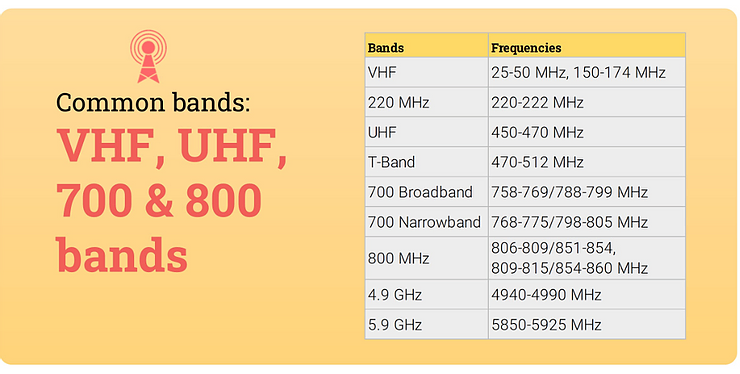
Signals with lower frequencies generally travel farther than those with higher frequencies. The FCC designates specific frequencies for the public safety spectrum, with VHF, UHF, 700, and 800 bands being the most commonly used for public safety. Local fire codes will specify which frequencies must be used in a building.
Type of Walls
Signal strength decreases as it passes through walls, with the amount of signal loss depending on the wall type. For instance, signals lose more strength passing through concrete walls than through drywall. Consequently, buildings with predominantly concrete walls may require more antennas than those with mostly drywall, even if the buildings are similar.
Why Do My Buildings Require ERCES Solutions?
If your organization owns an existing facility, is expanding that facility, or is constructing a new facility, then you need to know about emergency responder radio coverage (ERRC). More specifically, how to ensure your buildings and facilities work to enhance the communications signals used by public safety agencies to clearly and effectively communicate while responding to emergencies.
If Public Safety Radio (PSR) signals are blocked or otherwise impeded by the materials used in the construction of your offices, manufacturing plants, and other structures, your employees and the first responders deployed to save their lives are put at unacceptable levels of risk. Not only are the lives and well-being of your people at risk but so is your organization’s ability to operate those facilities.

Should any of your structures fail inspection by local fire marshals, you can have your certificate of occupancy (COO) revoked or, in the case of new construction, find it impossible to obtain a new certificate in the first place. Being unable to operate your business while ensuring maximum safety levels can considerably impact your organization’s bottom line — impeding your ability to conduct business while creating legal and public relations issues due to lax organizational safety standards.
Who Is Responsible For Testing And Maintaining In-Building ERRC Levels?
General Contractors, building owners, and building operators are responsible for having their facilities tested by certified Public Safety Radio DAS (ERCES) professionals. If those professionals determine a Public Safety BDA-DAS installation is required to boost in-building ERRC levels, the building’s responsible parties must install and test the system to ensure it passes all local, federal, and international code specifications.
What Standards And Codes Need To Be Met?
Public Safety Code requirements are established by the National Fire Protection Association (NFPA 72) and the International Fire Code (IFC 510) with the backing of the Federal Communications Commission (FCC) and local governments. Authorities Having Jurisdiction (AHJ), such as cities, counties, or Fire Marshal’s offices, can adopt or amend guidelines from either or both organizations to enforce in their areas.

With these building regulations, new building construction must meet a minimum level of emergency responder radio coverage as a condition for occupancy. The parties mentioned in the previous section are responsible for having their buildings tested by certified DAS professionals. If it’s determined your buildings’ signal levels are inadequate, then an enhancement system must be installed to get it up to code.
ICC Guidelines
The ICC provides guidelines for Public Safety DAS through the International Fire Code (IFC). Section 510 of the IFC outlines the requirements for Public Safety DAS, and it has been widely adopted and amended by many AHJs. The IFC regularly revises its guidelines to reflect the latest standards and practices.
NFPA Guidelines
The NFPA offers comprehensive guidelines for Public Safety DAS in the NFPA 72 – National Fire Alarm and Signaling Code. Chapter 24 of NFPA 72 is dedicated to Emergency Communications Systems (ECS), providing the latest safety provisions for fire detection and emergency communications. Additionally, NFPA 1221 details the standard for installing, maintaining, and using emergency services communications systems, covering all aspects from receiving calls to dispatching emergency units promptly and accurately.

Other Organizations with Relevant Guidelines
International Code Council (ICC)
International Building Code (IBC)
First Responder Network Authority (FirstNet)
These organizations have also developed guidelines pertinent to Public Safety DAS, providing additional resources for effective emergency communications.
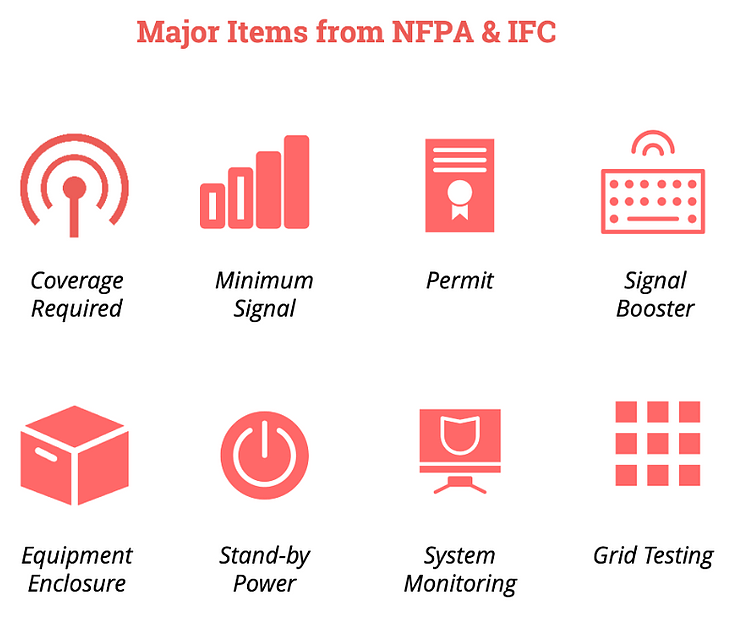
Major Items Covered by NFPA and IFC
Understanding the key topics covered by NFPA and IFC guidelines is crucial for architects, building owners, facilities managers, and constructors. Here are some major areas these guidelines address:
Coverage Required
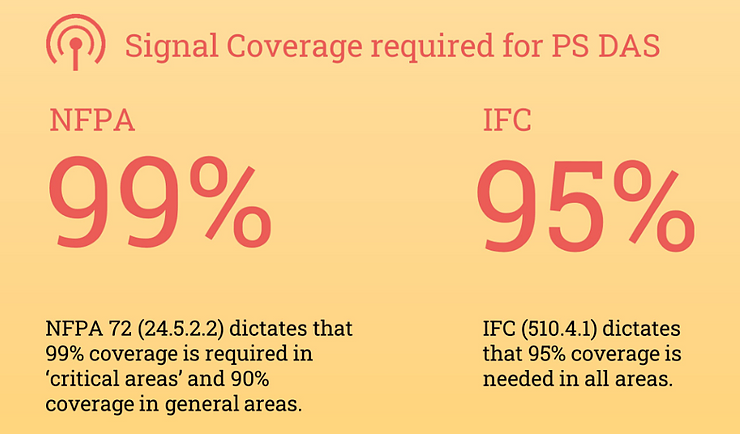
- NFPA 72 (24.5.2.2) mandates 99% coverage in critical areas such as fire command centers, fire pump rooms, exit stairs, exit passageways, elevator lobbies, standpipe cabinets, and sprinkler sectional valve locations, with 90% coverage required in general areas.
- IFC (510.4.1) requires 95% coverage in all areas. The specific coverage requirement in your area will depend on the local jurisdiction’s adoption of these guidelines.
- Minimum Signal Strength
Both NFPA 72 (24.5.2.3) and IFC mandate a minimum signal strength of -95 dB throughout the coverage area. This ensures reliable communication for emergency responders.
System Monitoring Alarms
- IFC (510.4.2.4) requires electrical supervision and monitoring of the BDA and battery system, with an option for an audible signal if approved by the fire code official.
- NFPA (24.5.2.6) requires detailed system monitoring through the fire alarm system and dedicated panels, covering signal booster failure, loss of AC power, battery charger failure, and low battery capacity.
Permit Requirements
- IFC (sections 510.3 and 105.7.5) requires a construction permit for installing or modifying PS-DAS systems and related equipment. Maintenance of existing systems does not require a construction permit.
Equipment Enclosures
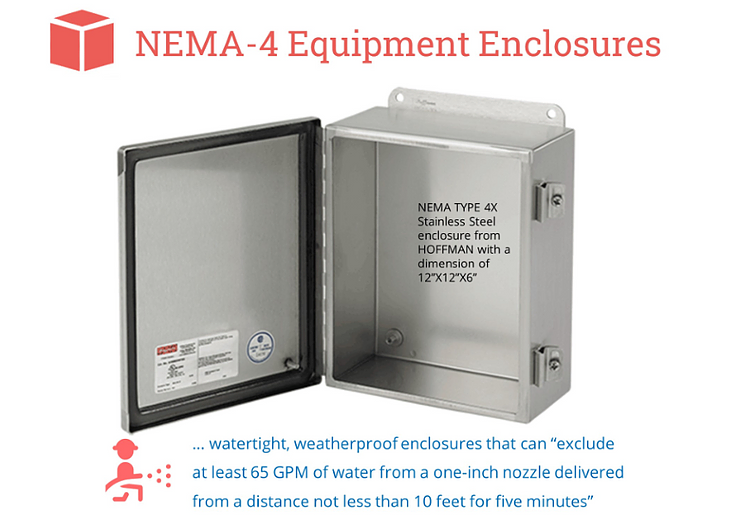
- NFPA (24.5.2.5.2) and IFC (510.4.2.4) stipulate that all equipment supporting the public safety network must be housed in a NEMA-4 compliant enclosure, which includes radios and power systems.
Grid Testing
- IFC (510.5.3) mandates grid testing, which divides each floor into 20 or 40 sections to ensure signal connectivity and compliance with minimum downlink and uplink requirements.
Stand-by Power
- IFC (510.4.2.3, 604.2.3) requires the standby power supply to operate the PS-DAS for at least 24 hours.
- NFPA (24.5.2.5.5) mandates two independent and reliable power supplies: a primary power source from a dedicated branch circuit and a secondary power source, which can be batteries (with at least 12 hours of operation capacity) or a generator (with at least 12 hours of operation capacity and batteries with at least 2 hours of operation capacity).
Signal Booster or BDA
- Both NFPA (24.5.2.2.3) and IFC (510.4.2.1) require FCC-certified signal boosters. Additionally, compliance with UL2524 (second edition) is required, ensuring adherence to standards such as NFPA 1221, the National Electrical Code (NFPA 70), the Fire Code (NFPA 1), and the Life Safety Code (NFPA 101).
FirstNet: The Future of Public Safety DAS
Today, first responders use over 10,000 separate, often incompatible radio networks, complicating communication during emergencies. The need for a unified network was highlighted after the 9/11 attacks, leading to the creation of FirstNet. FirstNet is a nationwide, interoperable LTE network dedicated to public safety communications, using Band 14 in the 700 MHz spectrum. It provides priority and preemption during network congestion.
All 50 states, five U.S. territories, and Washington, D.C., have adopted FirstNet, with AT&T contracted to build the network. If your local AHJ has not yet adopted FirstNet, it likely will in the future. Compliance with the existing public safety DAS rules remains necessary even with FirstNet implementation.
How Can MCA Help You Get Up To Code?
Mobile Communications America is a Tier 1 National Integrator of Public Safety Radio and Industrial-Grade Cellular Distributed Antenna Systems. We provide services every step of the way — including consultation, RF benchmark testing, iBwave design, solution engineering, system testing, and on-site installation. With our equipment service agreements, you can hire us to perform ongoing system monitoring and maintenance to ensure your buildings never fail to comply with local and federal codes. Contact us today for a free consultation and our monthly payment plan options.
Our Six-Step Process | MCA Is With You Every Step Of The Way

Discovery
MCA consultants work with large and small organizations to fully assess, determine the scope, and gather the requirements to provide a complete solution that fits your specific budget.

Site Survey + Design
RF Coverage is then tested, and if it is determined that a solution is required, MCA will formulate a plan and an iBwave design. Our design engineers are iBwave-certified and have years of in-building design experience.

System Installation
With 20+ years as a tier 1 DAS Integrator, MCA’s project managers and technicians have extensive expertise in installing any system, from a small, single-antenna BDA to a campus-wide DAS fiber solution.

System Commissioning
MCA’s engineering group will optimize each system component to ensure peak performance using advanced RF test tools and bring the system fully on air. MCA installers are certified in all DAS OEMs.

Inspection + Approval
Once the system is on-air and tested, the system is ready for AHJ inspection and final signoff. MCA project managers will handle all upfront permitting and back-end approvals to assure NFPA and IFC compliance.

Ongoing Support
Our equipment service agreements (ESA) include ongoing system support and annual site visits, and our in-house Network Monitoring System (NOC) notifies MCA of any issues for quick maintenance response.

About MCA
MCA is one of the largest and most trusted DAS integrators in the United States, offering world-class voice, data, and security solutions that enhance the quality, safety, and productivity of customers, operations, and lives.
More than 65,000 customers trust MCA to provide carefully researched solutions for a safe, secure, and more efficient workplace. As your trusted advisor, we reduce the time and effort needed to research, install, and maintain the right solutions to make your workplace better.
Our team of certified professionals across the United States delivers a full suite of reliable technologies with a service-first approach. The MCA advantage is our extensive service portfolio to support the solution lifecycle from start to finish.
