
Ensuring Signal Integrity and Code Compliance
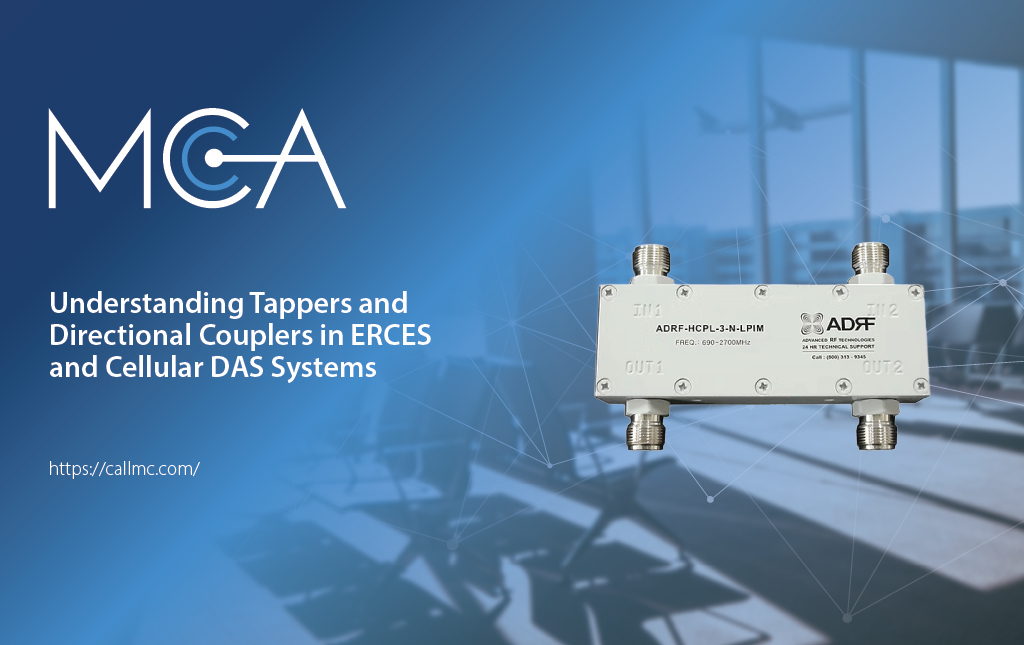
The reliability of Emergency Responder Communication Enhancement Systems (ERCES) and Cellular Distributed Antenna Systems (DAS) depends on the precise distribution of signals. While antennas, amplifiers, and head-end equipment often take center stage, one critical and often misunderstood component deserves equal attention: the tapper, also known as a directional coupler.
When operating in high-stakes environments like hospitals, high-rise buildings, airports, and sprawling campuses, even minor errors in RF distribution can lead to coverage gaps, failed code compliance inspections, and, most importantly, compromised safety.
Let’s demystify tappers and directional couplers to ensure your signal flows exactly where and how it should.
Not All Ports Are the Same
During field installations, it’s not uncommon to hear oversimplified assumptions like:
“The IN and OUT ports are basically interchangeable, right?”
This kind of thinking can derail even the most meticulously designed DAS or ERCES system. Tappers and directional couplers are engineered to manage and control signal levels with precision. Treating them as simple splitters, or worse, guessing their connections, can result in signal imbalances, coverage gaps, and system failures.
Anatomy of a Tapper: IN, THRU, TAP
Every tapper is built with three essential ports, each serving a specific purpose:
IN: This port receives the source signal, typically from the Bi-Directional Amplifier (BDA) or a preceding tapper.
THRU: This port continues the main trunk line with minimal signal loss, ensuring sufficient power for downstream antennas or additional tappers.
TAP: This port provides a controlled, lower-power signal branch designed to serve smaller coverage areas, such as individual rooms, closets, or secondary corridors.
Key Insight on Tapper Anatomy
The TAP port isn’t always connected directly to an antenna. It may feed another zone or additional tapper where only partial signal power is required. This is the very purpose of tappers: to distribute power optimally without overloading smaller branches.
How to Identify Ports Correctly
In the field, hardware often lacks proper labeling, which can lead to confusion. To correctly identify tapper ports, follow these steps:
Check For Decibel Markings: Ports labeled with values like -6 dB, -10 dB, or -20 dB are typically TAP ports. Any value under 3 dB usually indicates the THRU port.
Trace The Cables: The cable leading back to the BDA is your IN port. The line extending further into the system is your THRU port.
Use Testing Equipment: When in doubt, verify signal direction and loss characteristics with an RF power meter or spectrum analyzer.
What to Avoid
Mistakes in tapper connections aren’t just technical missteps. They can compromise life-safety systems in ERCES and disrupt public cellular services in DAS. Here are some common pitfalls to avoid:
Never connect the main trunk line to the TAP port. Doing so weakens the signal for downstream antennas and disrupts system balance.
Terminate unused TAP ports. Leaving them open can cause signal reflections and degradation. Always use a 50-ohm load.
Don’t treat tappers as splitters. Unlike splitters, tappers are directional and distribute uneven power intentionally. They are not reversible.
Field Rules for Success
To ensure a successful ERCES or DAS deployment, keep these golden rules in mind:
- IN: Connects to the source signal from the BDA or previous segment.
- THRU: Continues the main line to the next zone.
- TAP: Provides a controlled, lower-power branch.
- Terminate Unused TAP ports: Always use a 50-ohm load.
- Trace and Test: Never assume port functions. Always verify them.
Why Proper Tapper Configuration Matters
For ERCES, misconfigured tappers can result in non-compliance with NFPA 1225 or IFC requirements, jeopardizing occupancy permits and compromising first responder communications. In Cellular DAS, incorrect tapper setups can lead to poor indoor coverage, dissatisfied tenants, and costly site revisits.
When you consider the lives, investments, and critical communication systems at stake, proper tapper installation isn’t just a technical detail. It is a safety imperative.
Partnering with Experts
At MCA, we don’t just follow industry best practices. We set them. Our in-building wireless (IWS) teams specialize in the precise engineering, installation, and maintenance of ERCES and Cellular DAS systems nationwide. To eliminate confusion and ensure long-term reliability, we label all cables and system components during installation. This proactive step prevents issues with misidentified ports or connections, ensuring that every part of the system is clearly marked and easy to trace.
From advanced RF modeling to final sweep testing, we ensure every connector, cable, and tapper is configured to exacting standards. No guesswork, no compromises.
The occupants of your building and the first responders who protect them rely on dependable communication systems every day. A single misconnected tapper can disrupt that trust. Let’s get it right the first time, every time.
Contact MCA to ensure your ERCES or DAS system is designed and installed to the highest standards, safeguarding both compliance and lives.
About MCA
MCA is one of the largest and most trusted technology integrators in the United States, offering world-class voice, data, and security solutions that enhance the quality, safety, and productivity of customers, operations, and lives.
More than 65,000 customers trust MCA to provide carefully researched solutions for a safe, secure, and more efficient workplace. As your trusted advisor, we reduce the time and effort needed to research, install, and maintain the right solutions to make your workplace better.
Our team of certified professionals across the United States delivers a full suite of reliable technologies with a service-first approach. The MCA advantage is our extensive service portfolio to support the solution lifecycle from start to finish.
