
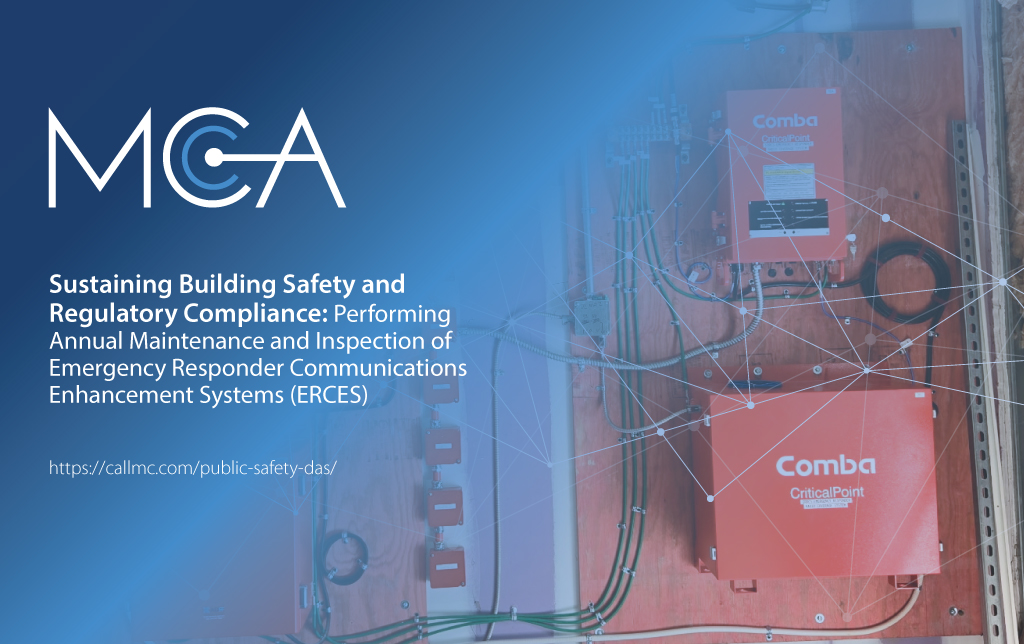
Sustaining Building Safety and Regulatory Compliance
Performing Annual Maintenance and Inspection of Emergency Responder Communications Enhancement Systems (ERCES)
The operational integrity of a building’s safety infrastructure is paramount for protecting occupants and emergency personnel. Among these critical systems, Emergency Responder Communication Enhancement Systems (ERCES), also known as Public Safety Distributed Antenna Systems (DAS), provide an essential lifeline. These systems ensure reliable communication for first responders during a crisis. However, the initial installation is only the first step. To guarantee performance when it matters most, ERCES requires diligent annual maintenance and compliance audits.
For building managers, facilities directors, and operations experts, understanding the necessity of these yearly checks is not just advisable—it is often a legal requirement. MCA is committed to delivering reliable voice, data, and security solutions, and we collaborate with our partners to ensure these critical systems are maintained to the highest standards.
This article details why annual ERCES maintenance is crucial and what the process entails.
The Critical Role of ERCES in Public Safety
ERCES is designed to overcome communication barriers within buildings. Materials like concrete, steel, and low-emissivity glass can block or weaken radio frequency (RF) signals, creating dead zones in areas such as basements, stairwells, and elevator shafts. An ERCES amplifies these signals, ensuring that firefighters, police, and paramedics can communicate without interruption inside a structure.
The importance of this capability cannot be overstated. During an emergency, seamless coordination is vital for executing rescue efforts, relaying critical information, and ensuring the safety of all first responders. A failure in the communication system can lead to dangerous delays, jeopardizing rescue operations and putting lives at risk.
Why Annual Maintenance and Audits Are Essential
While ERCES are engineered for high reliability, their performance can degrade over time due to various factors. Regular maintenance and audits are the only way to ensure the system remains fully operational and compliant.
Compliance with Fire and Building Codes
A primary driver for annual testing is regulatory compliance. National and local codes mandate regular maintenance and inspection of public safety communication systems. Building owners must keep their ERCES certified annually per codes such as NFPA 1225 (2022), IFC Section 510, and UL 2524, in addition to local Authority Having Jurisdiction (AHJ) mandates.
- International Fire Code (IFC): Sections 510.5 and 510.6 specify standards for the ongoing maintenance and testing of ERCES, including requirements for annual inspections to verify operational readiness.
- National Fire Protection Association (NFPA): Standards such as NFPA 1221 and 1225 outline detailed testing procedures that must be followed to ensure system safety and compliance.
Consequences for non-compliance can include fines, code violation notices, suspension of Certificate of Occupancy, increased legal liability in emergencies, and project delays. These risks highlight the importance not just of annual maintenance, but of thorough documentation and recertification.
Early Detection of System Issues
Routine maintenance serves a proactive purpose: identifying and resolving potential problems before they become critical failures. Issues can arise from component degradation, software glitches, or physical damage to cabling. Regular inspections allow trained technicians to spot these problems early, preventing system-wide failures during an actual emergency. Ongoing system logbooks should document maintenance, battery replacements, test results, equipment failures, and direct communications with the AHJ to provide inspectors with clear maintenance histories.
Maintaining System Dependability
The performance of an ERCES can be affected by changes within and outside the building. Structural renovations, new construction nearby, or even changes in interior layouts may interfere with RF signal paths and impact coverage. Annual audits involve re-evaluating the system’s performance in light of these changes to confirm it continues to meet original design specifications, providing consistent, reliable signal strength throughout the premises.
Ensuring First Responder Safety
Ultimately, the core purpose of an ERCES is to protect the first responders who enter a building during a crisis. A properly maintained system provides them with reliable communication tools they need to manage situations effectively and safely. If a system fails, even momentarily, it can jeopardize lives and create unnecessary risks.
Understanding DAQ 3.0 and its Role in Annual Compliance
A key component of ERCES annual compliance is the Delivered Audio Quality (DAQ) standard as defined by NFPA 1225. DAQ is a measure of how clearly a voice radio transmission can be understood across the building, rated on a scale from 1.0 (unintelligible) to 5.0 (excellent audio):
| DAQ Rating | Description |
| 1.0 | Unintelligible |
| 2.0 | Understandable with repetition |
| 3.0 | Understandable without repetition |
| 3.4 | Good audio quality |
| 4.0+ | Excellent audio, minimal noise |
Codes require a minimum DAQ of 3.0 in 95% of general areas and 99% of critical areas, such as stairwells, exit corridors, and mechanical rooms. Meeting this benchmark ensures that clear, actionable voice communication is always available to first responders.
DAQ can be assessed either subjectively by qualified testers or objectively using digital DAQ meters. If areas are found below DAQ 3.0, remediation—such as adding antennas, adjusting BDAs (Bi-Directional Amplifiers), or reconfiguring cabling—is required before a system can be recertified.
What Does an ERCES Maintenance Audit Involve?
A comprehensive annual ERCES recertification is a multi-step process managed by certified integrators with expertise in code compliance and RF engineering. Our teams collaborate with building managers to conduct structured assessments with minimal disruption.
Pre-Test Inspection and Documentation Review
The process begins with a thorough review of:
- Previous testing documentation and performance logs
- Floor plans and original grid layouts
- System configuration and equipment installation records
- AHJ approval documents and any prior recommendations or code violations
This initial review ensures the system’s ongoing maintenance aligns with both manufacturer specifications and evolving code requirements. It also provides auditors an overview of any modifications or environmental changes that may impact ERCES performance.
RF Grid Testing
Technicians perform a detailed RF survey using industry-standard Class A/B test equipment for both uplink and downlink frequencies. The process includes:
- Mapping signal strength in a 20×20-foot grid throughout general areas
- Conducting critical area tests in stairwells, pump rooms, elevators, and corridors
- Measuring signal quality against DAQ 3.0 standards and verifying that −95 dBm or better is maintained for coverage
Test results are then annotated on updated grid maps, highlighting pass/fail zones and guiding corrective actions for areas not meeting coverage or clarity benchmarks.
Battery and Power Backup Inspection
ERCES systems must remain functional during power outages. Annual maintenance includes:
- Load testing backup batteries (typically 12–24 hour capacity)
- Checking battery age, integrity, and compliance with expiration dates
- Verifying power supply pathways, fusing, and connection integrity
- Confirming that enclosures meet environmental protection standards (e.g., NEMA 4/4X)
Any weaknesses or outdated power components must be addressed before final recertification.
System Health Check and Monitoring Validation
The audit also includes end-to-end functional tests for all active system components:
- BDAs (Bi-Directional Amplifiers) for signal amplification consistency
- Donor antenna and all indoor distribution antennas
- Cabling checks for physical wear, corrosion, or connections issues
- Functional testing of system alarms and monitoring panels, including fire alarm interfacing
- Reviewing monitoring data or fault logs where remote monitoring is enabled
Issues discovered, whether alarm suppression, low gain, or component failure, are logged for remediation.
Documentation and AHJ Coordination
Upon completion of all fieldwork, a comprehensive report is compiled, including:
- Updated, annotated grid test maps with clearly identified pass/fail sections
- DAQ assessment results and signal strength logs for each area tested
- Equipment and enclosure inspection checklists
- Maintenance and repair logs tracking corrective actions taken
- All findings and supporting documentation submitted to the AHJ or fire marshal for recertification and Certificate of Occupancy renewal
Proper documentation is critical to demonstrate code compliance and address any questions from regulatory authorities.
Best Practices for Maintaining Audit Readiness
To avoid compliance issues and streamline annual audits:
- Follow a consistent testing schedule: Arrange ERCES recertification annually, without fail. Prompt, recurring testing helps demonstrate reliability during AHJ and fire marshal inspections.
- Maintain detailed system logbooks: Track each maintenance, repair, battery replacement, test, or equipment fault. Ensure logs and digital records are accessible for inspectors’ review.
- Educate your facility team: Make sure staff can recognize fault alarms, know the protocol for reporting issues, and understand how and when testing is scheduled.
- Partner with certified providers: Work with integrators experienced in public safety DAS, local code, and UL 2524-certified systems to ensure all code and documentation requirements are met efficiently.
- Plan for upgrades: Over time, radio environments, building occupancy, or nearby construction may necessitate coverage expansion or component upgrades. Annual testing identifies such needs early so coverage gaps can be closed before emergencies arise.
Partner with MCA for Unwavering Reliability
Maintaining an Emergency Responder Communication Enhancement System is a critical responsibility that directly impacts life safety. MCA helps solve our customers’ most important communication and security challenges with turnkey, integrated solutions. Our expert teams of certified professionals across the United States deliver a full suite of reliable technologies with a service-first approach. We manage the complexities of ERCES maintenance and compliance, allowing you to focus on the overall safety and efficiency of your facility.
Contact MCA today to ensure your public safety communication system is compliant, reliable, and ready to perform when it matters most.
About MCA
We believe every workplace should be safe, secure, and efficient. As trusted advisors, we deliver integrated communication, connectivity, and security solutions with a Service First mindset – driven by a team that cares deeply about our customers and each other.
Why MCA? At MCA, we help solve critical communication, connectivity, and security challenges with turnkey, integrated system solutions—from two-way radios and in-building wireless to video surveillance, access control, and more. MCA is built from over 50 companies with deep technical expertise and strong local roots. And we’re still growing—expanding our capabilities, our reach, and our team.
Our 100+ Solution Centers bring together sales, installation, service, and customer operations teams to deliver seamless, nationwide support. Guided by our Service First value, we don’t just connect the wires and walk away—we provide customized solutions backed by deep expertise and lifecycle support.
