
Unlocking the Grid: Can Cellular Finally Power a Mission-Critical FAN?
For decades, the utility industry has held a justified skepticism towards using public cellular networks for mission-critical grid operations. The core function of a Distribution Field Area Network (FAN) demands unwavering reliability, a standard that early-generation cellular technologies simply could not meet. This created a lasting perception: cellular is a best-effort service, unsuitable for the deterministic needs of supervisory control and grid modernization. However, the technological landscape has undergone a seismic shift. The arrival of 5G Standalone (SA) architecture, and specifically the 5G RedCap device class, challenges this old myth.
The conversation is no longer about whether cellular can be reliable, but rather how it can be engineered for mission-critical performance. Modern 5G networks offer capabilities that were once exclusive to private, wired infrastructure. This article will explore the evolution of cellular for industrial use, introduce the transformative potential of 5G RedCap, and outline how utilities can begin to build a resilient, future-proof FAN that strategically integrates this powerful wireless technology. As a trusted advisor, MCA is committed to educating our partners on these advancements, helping them navigate the complexities of network modernization.
From Unreliable to Indispensable: The Cellular Evolution
To fully appreciate the breakthrough that 5G represents, it’s essential to understand the limitations of its predecessors and why they earned a “bad rap” in the utility sector.
The 2G/3G Era: A Jittery Start
The first forays into cellular data were an afterthought to the primary function of voice calls. Networks in the 2G and 3G eras offered what was known as “best-effort” data service. This meant there were no guarantees. For a utility manager considering connecting a recloser or a SCADA remote terminal unit (RTU), the prospect of unpredictable latency and jitter was a non-starter. Critical command-and-control messages could be delayed or dropped during periods of network congestion, making these technologies too risky for anything beyond non-essential monitoring.
4G/LTE: A Major Leap with a Lingering Flaw
The arrival of 4G LTE brought a massive improvement in speed and capacity. It introduced more advanced radio technologies like OFDM and MIMO, making the network far more efficient. For consumers, this meant smooth video streaming and fast downloads. For utilities, it opened the door to new applications. However, a fundamental problem remained: it was still a shared resource.
Public LTE networks treated most data with the same level of priority. This meant a utility’s critical telemetry data packet was in the same queue as a teenager’s social media update or a commuter streaming music. During a “busy hour” or a large public event causing a spike in network usage, a phenomenon known as RACH (Random Access Channel) overload could occur, and essential grid communications could be crowded out. While private LTE networks offered a solution, the reliance on public networks for broad coverage still carried the risk of congestion-induced performance degradation.
The 5G Standalone and RedCap Revolution
The shift to 5G, and specifically the 5G Standalone (SA) architecture, is not just an incremental upgrade; it is a fundamental redesign. Unlike previous generations that often bolted new radio technology onto an old network core, 5G SA features an entirely new, service-based core built for a diverse range of applications, from consumer mobile broadband to massive IoT and critical industrial control.
This new core introduces three game-changing concepts for utilities:
- Guaranteed Quality of Service (QoS): The 5G core can assign specific QoS characteristics to different data flows using 5G QoS Identifiers (5QI). This allows a utility to define a Guaranteed Bit Rate (GBR) bearer for its most critical SCADA traffic, ensuring it receives the bandwidth it needs, regardless of other traffic on the network.
- Priority and Preemption: The network can be configured to prioritize certain traffic and, if necessary, preempt lower-priority traffic to free up resources. This means a FLISR command can be guaranteed passage even during a major network congestion event.
- Network Slicing: This allows a mobile network operator to partition its physical network into multiple virtual, end-to-end networks. A utility could subscribe to a dedicated network slice with guaranteed performance characteristics—latency, throughput, and availability—creating a private, high-performance network that runs over the operator’s public infrastructure.
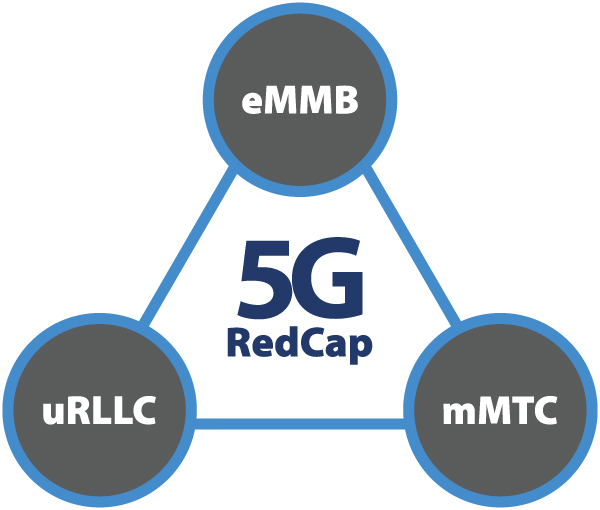
What is 5G RedCap?
Within this powerful 5G ecosystem, a new device category has emerged that hits the sweet spot for many utility applications: RedCap, or “Reduced-Capability” 5G.
RedCap is a standardized device profile that trims some of the complexity from high-end 5G modems. It uses narrower bandwidth and fewer antennas, which significantly reduces device cost, size, and power consumption. The crucial point is that it does this while retaining full access to the advanced features of the 5G SA core.
A utility can deploy a lower-cost RedCap device on a recloser or transformer monitor and still leverage GBR bearers, priority, and network slicing. It provides a “managed lane” on the cellular highway without needing to pay for a high-performance race car. This makes large-scale deployments for applications like FLISR, DERMS, and advanced metering infrastructure economically viable while ensuring mission-critical reliability.
Building a Hybrid FAN: The Best of Both Worlds
The most robust and practical approach to modernizing a FAN is not to choose between fiber and cellular, but to engineer a hybrid network that leverages the strengths of both. The blueprint for this architecture involves careful planning and traffic classification.
- Protection-Grade Paths: The most time-sensitive applications, like teleprotection (e.g., line current differential schemes), demand sub-millisecond latency and zero packet loss. These functions must remain on dedicated fiber or private MPLS circuits.
- Supervisory Control and Telemetry: This is the sweet spot for 5G RedCap. Applications like FLISR supervisory commands, DERMS setpoints, and most SCADA traffic require high reliability and low latency (typically in the tens of milliseconds), but not the microsecond-level performance of protection. A GBR bearer over a 5G RedCap link is an ideal and cost-effective solution.
- Operational and Management Traffic: Less critical data, such as routine polling, software patches, or non-real-time video, can be handled with a lower-priority, non-GBR bearer that is preemptible by more critical traffic.
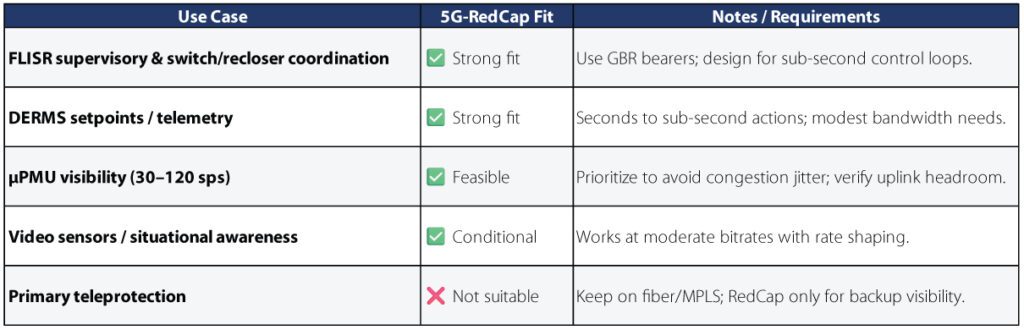
By working with a carrier to implement a private APN or a dedicated network slice, a utility can map these traffic classes to specific QoS policies in the 5G core. This ensures that even when the network is congested, supervisory commands are not delayed.
The Path Forward: A New Paradigm for Grid Communications
The narrative that cellular is too unreliable for mission-critical use is officially outdated. The combination of a 5G Standalone core and the 5G RedCap device class provides utilities with a powerful, flexible, and cost-effective tool for grid modernization. It enables a pragmatic FAN architecture where fiber is used for instantaneous protection, and 5G cellular provides a resilient, high-performance wireless fabric for the vast majority of supervisory, monitoring, and control applications.
This article has only scratched the surface of this complex and transformative topic. To gain a deeper understanding of the specific technical mechanisms, architectural blueprints, and implementation strategies, we invite you to download our full white paper.
MCA serves as a trusted advisor to utilities navigating these complex technological shifts. We partner with our customers to design, implement, and manage robust communication networks that blend the best of wired and wireless technologies. Determining whether 5G RedCap, private LTE, or another solution from our extensive portfolio is the right fit requires a collaborative consultation to assess your unique operational requirements. Our team of experts is ready to help you build a FAN architecture that is not only practical and fundable but also prepared for the future of the grid.
About MCA
We believe every workplace should be safe, secure, and efficient. As trusted advisors, we deliver integrated communication, connectivity, and security solutions with a Service First mindset – driven by a team that cares deeply about our customers and each other.
Why MCA? At MCA, we help solve critical communication, connectivity, and security challenges with turnkey, integrated system solutions – from two-way radios and in-building wireless to video surveillance, access control, and more. MCA is built from over 50 companies with deep technical expertise and strong local roots. And we’re still growing – expanding our capabilities, our reach, and our team.
Our 100+ Solution Centers bring together sales, installation, service, and customer operations teams to deliver seamless, nationwide support. Guided by our Service First value, we don’t just connect the wires and walk away – we provide customized solutions backed by deep expertise and lifecycle support.
